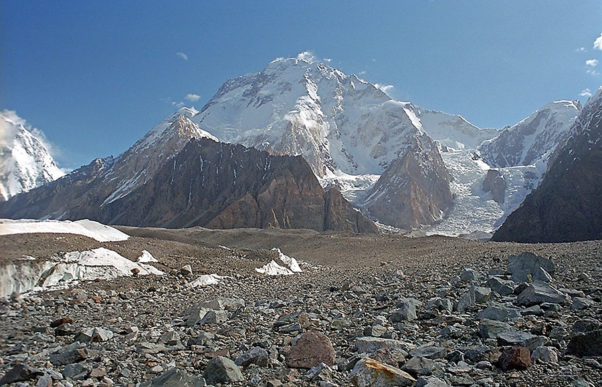
Here at The Adventure Blog we cover a lot of interesting stories about people climbing 8000-meter peaks. It isn't often however that we share a story about someone who found another way to reach the mythical 8000-meter mark that doesn't involve ropes, crampons, and down suits. Earlier this week it was revealed that French extreme paraglider Antoine Girard managed to do just that when he sailed above the summit of Broad Peak in Pakistan, rising to some 8100 meters (26,574 ft) in the process.
According to Brad Sander, an American adventure pilot living in Pakistan, Antione approached him a few weeks back inquiring about renting oxygen bottles for the flight. Sander called Girard's accomplishment "the flight of the century," while helping to fill in some of the details about how all of this came together.
Apparently, Antoine shoed up in Pakistan with a friend in tow. Unfortunately, that friend was part of the French military, so his entry visa was denied. This caused Girard to scramble his plans some, but he met up with some other paragliders in country that helped get him acclimated. After that, he took off for the Karakoram, where he spent three weeks exploring the area and making flights around the mountains there, including the 8126 meter (26,660 ft) Nanga Parbat.
Once he learned how the thermals in the area worked, and became accustomed to the weather conditions there, the Frenchman hatched a plan. Climbing up to the Baltoro Glacier, he camped for a couple of nights while he made his preparations. On July 23, he took flight, gliding over the famous Trango Tower on his way to Concordia, a place where few paragliders have ever flown before. From there, he could see Nanga Parbat, K2, and Broad Peak.
After he got the lay of the land, Antoine was ready to go for it. He climbed above 6500 meters (21,325 ft), then set off in his paraglider. Catching thermals he was able to rise higher and higher, eventually reaching the summit of Broad Peak itself, which sits at 8051 meters (26,414 ft). This makes him the first person to actually fly to the summit of an 8000 meter peak in this manner.
Antonie is currently in transit back to France, but we're told that he has GoPro footage of the flight. You can bet that we're eagerly waiting to see how that turns out. It should definitely be very interesting. In the mean time, you can read all about his adventure here.
Thursday, July 28, 2016
Kilian Jornet Officially Announces Everest Speed Record Expedition
We've known that it was coming for some time, but today Spanish ultrarunner/mountaineer Kilian Jornet has officially announced his attempt to set a new speed record (Fast Known Time (FKT) in his parlance) on the world's highest peak, Mt. Everest. And as usual, he'll be making the attempt in his own unique, unorthodox, and challenging way.
In a press release sent out this morning, Jornet says that he'll be making the climb throughout August and September. But prior to leaving for the Himalaya, he'll first begin to acclimatize in the Alps closer to home. For the next few weeks, Kilian and his support team will live and train in the European mountains as they begin to get their bodies ready for the demands that they'll face once they head to Tibet.
The plan is to attempt to summit Everest from the North Side, along a route that sees little traffic. The exact route hasn't been made clear yet, as the intention is to scout the mountain once they are there. What they find on the slopes of the mountain will ultimately decide which way he will go to the top.
The final summit push will begin at Rongbuk monastery and will continue all the way to the top of Everest, and then back down again. In all, Kilian will have to run about 30 km (18.6 miles), which is a short distance for a man who is use to competing in 100 mile (160 km) long races. But, he has never tested himself at such high altitudes before, so it is unclear how his body will respond. This will be the Spaniard's first attempt at an 8000-meter peak, but despite that he still intends to have a go at the FKT in alpine style and without the use of bottled oxygen.
Additionally, one has to wonder how much of an impact acclimatizing in the Alps will have on his progress. The highest peak in that mountain range is Mont Blanc, which stands 4810 m (15,781 ft) in height. That is not insignificant of course, but it is not even the same height as Base Camp on Everest. In other words, he'll still have a lot of work to do once he arrives in the Himalaya.
Right now, the plan is to depart Europe on August 7 to start the expedition. Kilian and his crew will then spend the next eight weeks prepping and planning for the run. Will he be able to set a new speed record on the highest mountain on the planet? Only time will tell, but I wouldn't doubt the man who set speed records on other mountains like Mont Blanc, Aconcagua, Denali, and Kilimanjaro. Still, Everest is an entirely different beast, and it will be interesting to watch this all unfold.
Stay tuned.
In a press release sent out this morning, Jornet says that he'll be making the climb throughout August and September. But prior to leaving for the Himalaya, he'll first begin to acclimatize in the Alps closer to home. For the next few weeks, Kilian and his support team will live and train in the European mountains as they begin to get their bodies ready for the demands that they'll face once they head to Tibet.
The plan is to attempt to summit Everest from the North Side, along a route that sees little traffic. The exact route hasn't been made clear yet, as the intention is to scout the mountain once they are there. What they find on the slopes of the mountain will ultimately decide which way he will go to the top.
The final summit push will begin at Rongbuk monastery and will continue all the way to the top of Everest, and then back down again. In all, Kilian will have to run about 30 km (18.6 miles), which is a short distance for a man who is use to competing in 100 mile (160 km) long races. But, he has never tested himself at such high altitudes before, so it is unclear how his body will respond. This will be the Spaniard's first attempt at an 8000-meter peak, but despite that he still intends to have a go at the FKT in alpine style and without the use of bottled oxygen.
Additionally, one has to wonder how much of an impact acclimatizing in the Alps will have on his progress. The highest peak in that mountain range is Mont Blanc, which stands 4810 m (15,781 ft) in height. That is not insignificant of course, but it is not even the same height as Base Camp on Everest. In other words, he'll still have a lot of work to do once he arrives in the Himalaya.
Right now, the plan is to depart Europe on August 7 to start the expedition. Kilian and his crew will then spend the next eight weeks prepping and planning for the run. Will he be able to set a new speed record on the highest mountain on the planet? Only time will tell, but I wouldn't doubt the man who set speed records on other mountains like Mont Blanc, Aconcagua, Denali, and Kilimanjaro. Still, Everest is an entirely different beast, and it will be interesting to watch this all unfold.
Stay tuned.
Wednesday, July 27, 2016
Video: Mongolia with Tusker Trail in 100 Seconds
I'll begin sharing the tale of my Mongolia adventure tomorrow, but in the meantime I wanted to share a sneak peek at what my journey was actually like. I traveled to the remote Asian country with my friends at Tusker Trail. For about two weeks I explored the Altai Tavn Bogd National Park on horseback and foot. To say that this was unlike any other travel experience that I have had before would be an understatement, but as you'll see in the clip below it was an incredibly rewarding experience, and one that you'll want to have on your bucket list too.
Labels:
Adventure Travel,
Altai Mountains,
Asia,
Horse,
Mongolia,
Trekking,
Video
Video: GoPro Camera Captures Hyperlapse Images of Solar Impulse Flight
Yesterday I posted a story about the Solar Impulse aircraft completing its round-the-world journey using nothing but the rays of the sun to power the flight. Today, I have a great video that was captured by GoPro camera throughout the expedition. The short clip is a hyperlapse of final legs of the excursion, giving us some impressive views of the trip as seen from atop the plane itself. This was a wonderful achievement to say the least, and this video helps to put the accomplishment in perspective.
Russian Adventurer Sets Record For Fastest Circumnavigation By Balloon
I'm still working hard to catch up with some of the big stories that broke while I was away in Mongolia. Most have been covered now, but there was at least one more that I wanted to share. This past weekend, Russian adventurer Fedor Konyukhov completed an epic round-the-world journey in a hot air balloon, covering some 33,000 km (20,506 miles) while setting a new speed record in the process.
Konyukhov first set out on his journey back on July 12, taking to the air at 7:30 AM local time at a point located just north of Perth, Australia. He touched down just 11 days later in the town of Bonnie Rock, located in Western Australia at about 5:00 PM in the evening.
In completing the journey, the 64-year old Russian becomes just one of four people to successfully circumnavigate the globe in a balloon. He is the second to do so solo. Konyukhov circled the planet in a carbon fiber pod that was not pressurized, as he cruised along at speeds in excess of 150 miles (240 km) per hour, at an altitude that often reached to 30,000 feet (9144 meters). His speed record is two days faster than the previous mark, which was set by Steve Fossett back in 2002.
This latest achievement is just one of many for the Russian, who has scaled Everest twice, climbed the rest of the Seven Summits, and has skied to both the North and South Pole. He has even visited the Pole of Inaccessibility in the Arctic Ocean, and crossed the Pacific Ocean in a rowboat. An accomplished sailor, Konyukhov has sailed around the world four times, a skill that served him well in the balloon too.
Some of the challenges that he faced while flying around the globe in a balloon included bad weather, a frozen valve on his oxygen tanks, and a storm that froze over the balloon, adding enough additional weight that the flight was in serious jeopardy for a time. At one point, he even strayed far enough south that he was nearing Antarctica, just as his onboard heater was struggling to continue working. This put him into "survival mode" as he strayed into serious jeopardy for a time. Thankfully, he was able to overcome all of those obstacles, stay in the air, and still set the new speed record.
Congrats to Fedor on such an impressive accomplishment. Truly a great adventure for the modern age.
Konyukhov first set out on his journey back on July 12, taking to the air at 7:30 AM local time at a point located just north of Perth, Australia. He touched down just 11 days later in the town of Bonnie Rock, located in Western Australia at about 5:00 PM in the evening.
In completing the journey, the 64-year old Russian becomes just one of four people to successfully circumnavigate the globe in a balloon. He is the second to do so solo. Konyukhov circled the planet in a carbon fiber pod that was not pressurized, as he cruised along at speeds in excess of 150 miles (240 km) per hour, at an altitude that often reached to 30,000 feet (9144 meters). His speed record is two days faster than the previous mark, which was set by Steve Fossett back in 2002.
This latest achievement is just one of many for the Russian, who has scaled Everest twice, climbed the rest of the Seven Summits, and has skied to both the North and South Pole. He has even visited the Pole of Inaccessibility in the Arctic Ocean, and crossed the Pacific Ocean in a rowboat. An accomplished sailor, Konyukhov has sailed around the world four times, a skill that served him well in the balloon too.
Some of the challenges that he faced while flying around the globe in a balloon included bad weather, a frozen valve on his oxygen tanks, and a storm that froze over the balloon, adding enough additional weight that the flight was in serious jeopardy for a time. At one point, he even strayed far enough south that he was nearing Antarctica, just as his onboard heater was struggling to continue working. This put him into "survival mode" as he strayed into serious jeopardy for a time. Thankfully, he was able to overcome all of those obstacles, stay in the air, and still set the new speed record.
Congrats to Fedor on such an impressive accomplishment. Truly a great adventure for the modern age.
The Adventure Racing World Series is Coming to China!
Over the past few years the Adventure Racing World Series has taken some of the best adventure races in the world and brought them together to create a unified set of events that works towards crowning a world champion in the sport each year. The system has brought order to AR, which in the past has generally consisted of numerous races that operated independently of one another without any type of consistency or cooperation.
While the current state of adventure racing is very different from what it was a decade ago, I'd venture to say that the sport is as healthy now as it has ever been, which much of the credit for that going to the ARWS. If you're looking for further proof of this, one only needs to look to the recent announcement that adventure racing is coming to China this September in the form of the Xtrail Expedition Race.
For now, the Xtrail is operating as a demonstration event for the ARWS, but it is the first officially sanctioned race to be held in Asia. The event will be held in the remote Altay region of the Xinjiang province, in far northwestern China. It will feature the usual disciplines of mountain biking, kayaking, and trail running, all set in a place unlike any most of the competitors have seen before.
In order to lure teams to the event, the organizers of the Xtrail are offering a number of great incentives. Those include a reduced price entry fee of $1,000 USD per team, free transfers to/from Urumqi (arrival city) to Altay (race city), all accommodations and some food in Altay, and a $600 USD cash payment per international athlete on arrival to assist with travel expenses in China. In other words, they are serious about attacking top teams and want to make the process has simple and painless as possible.
Entry into the race is listed to just 25 international teams and 25 Chinese teams, so if you're interested in joining in on the fun, you'll want to sign up soon. The Xtrail will take place on September 23-28, and will cover roughly 300 km (186 miles). Need further incentive? The prize purse for the event is expected to top out at $50,000 USD.
Find out more at the ARWS website.
While the current state of adventure racing is very different from what it was a decade ago, I'd venture to say that the sport is as healthy now as it has ever been, which much of the credit for that going to the ARWS. If you're looking for further proof of this, one only needs to look to the recent announcement that adventure racing is coming to China this September in the form of the Xtrail Expedition Race.
For now, the Xtrail is operating as a demonstration event for the ARWS, but it is the first officially sanctioned race to be held in Asia. The event will be held in the remote Altay region of the Xinjiang province, in far northwestern China. It will feature the usual disciplines of mountain biking, kayaking, and trail running, all set in a place unlike any most of the competitors have seen before.
In order to lure teams to the event, the organizers of the Xtrail are offering a number of great incentives. Those include a reduced price entry fee of $1,000 USD per team, free transfers to/from Urumqi (arrival city) to Altay (race city), all accommodations and some food in Altay, and a $600 USD cash payment per international athlete on arrival to assist with travel expenses in China. In other words, they are serious about attacking top teams and want to make the process has simple and painless as possible.
Entry into the race is listed to just 25 international teams and 25 Chinese teams, so if you're interested in joining in on the fun, you'll want to sign up soon. The Xtrail will take place on September 23-28, and will cover roughly 300 km (186 miles). Need further incentive? The prize purse for the event is expected to top out at $50,000 USD.
Find out more at the ARWS website.
Melissa Arnot and Maddie Miller Undertake 50 Peaks Challenge
One of the true adventurous undertakings in the U.S. it to attempt to reach the highest spot in each of the 50 individual states. If one wanted even more of a challenge they would try to do so in just 50 days as well. That's exactly what mountaineers Melissa Arnot and Maddie Miller are attempting to do at the moment, as they are currently in the midst of the 50 Peaks Challenge, as they strive to become the first women to nab each of the high points.
The list of high points across the U.S. is quite diverse. At one end of the spectrum you have Britton Hill in Florida, which is a mere 345 feet (105 meters) above sea level and barely a challenge at all. On the other hand, Denali in Alaska is a stunning 20,308 ft (6189 meters), and a true mountaineering challenge. In between you'll find all kinds of other mountains and hills, most of which are mere walk-ups. Still, nabbing all of them in under 50 days remains a significant achievement in no small part because of the travel time involved.
Melissa and Maddie began their challenge by summiting Denali earlier this spring, and have now been slowly but surely ticking off the other high points as they go. At this point, they've now reached the highest elevation in 43 different states, with Wyoming, Utah, Nevada, California, Oregon, Washington, and Hawaii yet to go. Each of the mountains in those states are above 10,000 feet (3048 meters), which means they will all present a unique challenge. But, considering the resumes that these two ladies bring to the table, they should certainly not have too much of a problem claiming them all.
You can follow their progress on Melissa's website as they close in on the end. Check out the video below for a preview of the challenge as well.
50 Peaks Challenge - Trailer from Eddie Bauer on Vimeo.
The list of high points across the U.S. is quite diverse. At one end of the spectrum you have Britton Hill in Florida, which is a mere 345 feet (105 meters) above sea level and barely a challenge at all. On the other hand, Denali in Alaska is a stunning 20,308 ft (6189 meters), and a true mountaineering challenge. In between you'll find all kinds of other mountains and hills, most of which are mere walk-ups. Still, nabbing all of them in under 50 days remains a significant achievement in no small part because of the travel time involved.
Melissa and Maddie began their challenge by summiting Denali earlier this spring, and have now been slowly but surely ticking off the other high points as they go. At this point, they've now reached the highest elevation in 43 different states, with Wyoming, Utah, Nevada, California, Oregon, Washington, and Hawaii yet to go. Each of the mountains in those states are above 10,000 feet (3048 meters), which means they will all present a unique challenge. But, considering the resumes that these two ladies bring to the table, they should certainly not have too much of a problem claiming them all.
You can follow their progress on Melissa's website as they close in on the end. Check out the video below for a preview of the challenge as well.
Subscribe to:
Posts (Atom)