Friday, August 26, 2016
Video: The Northern Lights as Viewed From a Drone
What do you get when you fly a drone into the Northern Lights? Why this spectacular video of course. Shot on the Reykjanes Peninsula in Iceland, where the stunning landscapes found there are illuminated by the otherworldly light given off by the aurora borealis. This is a fitting way to wrap up another busy week, and a two-minute video that everyone should see. Enjoy!
Northern Lights shot with a Drone from O Z Z O Photography on Vimeo.

Video: Grand Teton National Park as You've Never Seen it Before
We continue our theme of sharing videos from America's national parks today with this amazing clip from our friends over at Teton Gravity Research. They take us deep into Grand Teton National Park to give us a look at the place at it has never been seen before. As you'll see, it is wilderness playground unlike any other, and due to its proximity to Yellowstone, an often overlooked destination for adventure.
Gear Closet: Victorinox Traveller Lite Swiss Army Knife

Recently, I carried the Victorinox Traveller Lite with me on my trip through Mongolia, and as usual, it proved itself to be a handy companion. The knife comes equipped with everything you need, and a few things you didn't even know you wanted, making it a useful item to have in your pack or pocket at just about any time.
Sorting through the incredibly long catalog of knives on the Victorinox website will probably leave your head spinning. There are so many choices to examine that it can be difficult to find the one that best suits your exact needs. But, the Traveller Lite was certainly a good choice for me, as it features just about every tool imaginable, including both large and small knife blades, a can opener, screw driver, a bottle opener, a corkscrew, scissors, and more. In short, it has about every tool you wold expect from a Swiss Army Knife, and they are all squeezed into a small enough space that it can easily be slipped into your pocket.
One thing that does set this knife apart from the scores of others that Victorinox makes is a small LCD screen that can be found on its translucent case. That screen displays the time, temperature, altitude and barometric pressure, all of which are handy features to have in the backcountry. The tiny screen is powered by a small watch battery that slides into a specially designated slot. That slot was kind of challenging to gain access to at first, but thankfully you shouldn't have to change the battery too often.
In terms of build quality, the Traveller doesn't disappoint. It feels solid in your hands, and as with most other Swiss Army Knives it has been designed to survive in demanding environments. Using the various tools doesn't give you the sense that anything is about to break, nor does it seem like any corners were cut in designing and assembling this product. I can't always say the same about similar knives I've used in the past, some of which have failed me at the most inopportune times. As with all knives from Victorinox, this one comes with a lifetime warranty as well, which means if something should break, you'll get it replaced for free.
I carried this knife with me everyday while in Mongolia, and even I was surprised at the number of times I pulled it out to use one of the various tools. The knife blades were probably the ones I needed most often in that setting, but others such as the integrated tweezers and toothpick came in handy from time to time too. At times, it felt like I was carrying a full tool box in compact form right in my pocket.
The Traveller Lite is one of the more expensive knives in the Swiss Army collection. At $111 it is probably a bit pricey for most outdoor enthusiasts who don't need all of its features. For those folks, I'd recommend something like the Huntsmen, which has many of the same tools – minus the electronic gadgetry – and sells for just $40. But, if you're someone who ventures into the backcountry often, or does a lot of mountaineering, the Traveller Lite is a good option. It's LCD screen displays some important information, and it provides plenty of good tools to see you through some demanding trips. For those folks, the $100+ price tag is worth the investment, and you'll likely have a tool that will accompany you on my future adventures.
Check out the entire line of Victorinox knives and other products at Victorinox.com.
Adventure Travel Briefs: A Cruise Ship in the Northwest Passage and Is Adventure Travel Endangered?

Luxury Cruise Ship Sails the Northwest Passage
In recent years, climate change has allowed the famed Northwest Passage – an area of open sea in the Arctic Ocean above Canada – to become far less treacherous and more navigable by boat. In the past, the ice would either stay locked in place even during the summer months, or the route would remain dangerous due to large ice bergs choking the path. That isn't the case any longer, and for several months each year it is possible to sail from the Atlantic to the Pacific via the Arctic.
Now, a luxury cruise ship by the name of Serenity has embarked on a 32-day journey across the entire passage. The ship set sail from Seward, Alaska last week, and is now making its way towards New York City. While small ships have made their way along the legendary route in recent years, this is the first time a large ship has done so. The Serenity can carry more than 1700 people.
Hopefully the cruise goes off without any major issues. The Canadian Coast Guard estimates its response time to an emergency at 11 hours. That's a long time should anything go wrong. Fingers crossed this doesn't become a major trend either, as the Arctic Ocean is still a very fragile ecosystem.
Richard Bangs Takes Us to Madagascar
Mysterious and enchanting, Madagascar is high on my places to visit that I haven't been lucky enough to get to just yet. I'm even more intrigued after reading Richard Bangs' recent article for The Huffington Post, in which he delves into the history, culture, and people that live on the island country just off the coast of Africa.
In the incredibly well written piece, Bangs paints an impressive picture of the place, which is at a crossroads environmentally, and yet is still a fascinating ecological preserve filled with creatures that aren't found anywhere else on Earth. Amongst those creatures are Madagascar's famous lemurs, which are held in high regard by the locals and it is strictly forbidden to kill. But in his travel through the land, Richard goes in search of a rumored restaurant that allegedly serves lemur on the menu. Does he find it? And what other wonders does he discover there? Read on to find out.
Is Adventure Travel an Endangered Species?
Our final adventure travel story come from the blog at Tusker Trail. The article was written awhile back, but still asks an intriguing question – Is adventure travel an endangered species? In the article, the author indicates that fear and a desire for safety and security are causing many travelers to abandon their hopes of living an adventurous life, with many now playing it safe and sticking close to home.
With terrorist attacks taking place all over Europe, strange diseases like Ebola and Zika, striking Africa and South America, and other potential threats making headlines, it is easy to get caught up in the belief that danger is lurking around every corner when you start to wander too far from home. But, in reality, we all know that isn't the case, and that these are mostly isolated incidences that are far from the norm.
Yes, travelers do accept that there is always the potential for danger when setting out on an adventurous excursion. But, isn't that a part of adventure travel? As the Tusker article says, adventure travel may be compromised, but it is far from dead. There are still plenty of amazing places to go, things to do, and sites to see. As the author says, study your destination thoroughly, do your homework ahead of time, and know what you're getting yourself into. Chances are, you'll be better prepared to deal with situations as they arise, and probably avoid danger altogether. At the very lest, don't let fear keep you from traveling the world and seeking out adventure.
Something I agree with wholeheartedly.
Himalaya Fall 2016: Busy Season Ahead in Nepal

According to this story from The Himalayan Times Manaslu will be the favorite target for the climbing teams this autumn. About 100 foreign climbers have received permits to attempt the 8163 meter (26,781 ft) peak, with the first 40 mountaineers departing from Kathmandu yesterday. They'll spend a few days trekking before reaching Base Camp, but should get there sometime late next week, just as the fall season – which traditionally runs from September to November – starts to get underway.
Other mountains that will be seeing some traffic this fall include Dhaulagiri and Lhotse, as well as non-8000 meter peaks Ama Dablam, Himlung and Putha Hiuchuli. Those mountains won't have nearly as many men and women on their slopes however, as Manaslu remains the big draw.
As has become typical for this time of year, there are no reported attempts on Everest from the South Side at this time. That could change as more climbers apply for their permits, but as of now Spanish ultrarunner Kilian Jornet and Japanese mountaineer Nobukazu Kuriki are the only ones who will challenge the world's highest peak this season. Both will make their ascent from the North Side.
According to the story from the Times, some of these groups will be quite large. For instance, Seven Summits Treks will lead four groups consisting of 60 climbers on Manaslu themselves, which may be as much as half of the number of foreign climbers heading to Nepal this autumn.
Following the tragic earthquake last spring, it was good to see mountaineers returning to Nepal this year. By most accounts, the spring climbing season was a highly successful one, and the fall looks to continue that success. Of course, all of these expeditions employ Sherpa guides and high altitude porters, which brings much needed cash to the economy of Nepal as well. We'll of course be keeping a close eye on the proceedings there, and will report any news moving forward.
Gadd luck to everyone heading into the mountains. Stay safe!
Thursday, August 25, 2016
Video: Powerful Yellowstone in Timelapse
Most of the videos I've shared this week have centered around America's national parks in some way, and this one is no exception. This time we travel to Yellowstone – the first national park in the entire world – to catch a glimpse of the powerful forces at work there. Through timelapse video you'll see some of the park's famous geothermal anomalies at work, as just below the surface sits one of the most powerful super volcanoes on the entire planet. This is part of what makes Yellowstone so special, and seeing it captured in this manner is incredibly impressive indeed.
SKYGLOWPROJECT.COM : HADES EXHALES from Harun Mehmedinovic on Vimeo.
Video: Celebrating 100 Years of America's National Parks
If you've been reading The Adventure Blog this week, you know that today is the 100th anniversary of the founding of America's National Park Service. This video comes our way courtesy of CBS, and it was made with one purpose - celebrating 100 year of the national parks. This is a momentous occasion indeed, so sit back and enjoy this four-minute clip that will remind you of why these places are so special.
Gear Closet: Catalyst Apple Watch Waterproof Case

All of that said, there are times when I wish the Apple Watch were a bit more rugged. Sometimes I'll wear it on my outdoor adventures, and it seems a bit fragile for use in the backcountry. Especially if I'm doing anything that involves being out on the water. Don't get me wrong, the Watch can survive a dunking, but Apple falls short of actually declaring it water proof, and you're on your own if you go swimming with it. Which is why I was eager to try out the Apple Watch Case from Catalyst, a product that promises to add rugged protection to the smartwatch and even protect it from water.
The Apple Watch Case is certified to the IP68 standard, which means it will keep your watch waterproof down to 50 meters (165 ft). It has also been built to the MIL-SPEC 810G standard for protection against drops as well, giving your Apple Watch a suit of armor that protects it from the elements. Those two factors alone make it a worthwhile product for anyone who like to wear their smartwatch in the outdoors, as you'll definitely feel more confident when it is wrapped up in this protective shell.
Installing the Apple Watch Case is surprisingly easy. There is one tiny screw to remove (Catalyst includes a proper screw driver in the packaging) to gain access to the interior of the case. Before doing so, you simply remove the current watch band that you have on the Apple Watch – a process that takes seconds – and then place the watch housing itself inside a thin rapper seal that provides an extra level of protection from moisture. Then, you place it into the case and reseal it using the same screw and screw driver.
When it clicks into place, the housing is completely sealed tight, yet you lose no functionality. The watch face remains just as responsive to your touch as it was before and the device can continue to monitor your heart rate, provide haptic feedback, use the speaker and mic, and connect to its magnetic charger. Catalyst has even cleverly designed buttons and a digital crown to fit over the existing versions on the Watch itself, allowing full interaction with all its features. In fact, after installing the case on my Watch I almost forgot that I had made the change, as it felt just as natural interacting with it as before, and the case felt incredibly comfortable on my wrist at all time.
Last week, while traveling in Quebec, I had the opportunity to truly put the Apple Watch Case to the test. Many of the activities took place on the water, so I spent my days stand-up paddleboarding, kayaking, canoeing, and even whitewater rafting. Throughout all of those activities the case performed exactly as advertised, keeping my precious Apple Watch fully protected. I even jumped out of the raft and body surfed some rapids on my own, and my device came out completely unscathed. It was an impressive display to say the least, and it convinced me that the case would keep my watch fully protected just about anywhere.
As mentioned, the case is quite comfortable to wear, and doesn't add a lot of bulk to Apple's sleek smartwatch. In fact, after my trip was over I debated as whether or not I should just leave it on permanently. In the end, I did remove it (also a simple affair) in part because I enjoy the versatility of being able to change up the look of the Apple Watch on a moment's notice. But, knowing that I have Catalyst's case at my disposal for future adventures makes me very happy.
The Catalyst Apple Watch case is available for the 42mm version only and costs $59.99. To me, it is a worth investment if you like to use your Apple Watch while traveling or exploring the outdoors. It definitely adds a great level of protection that isn't there out of the box, and will allow it to survive being immersed in water without any fears.
Find out more at CatalystCase.com.
Use of Helicopters on Everest Rises Dramatically

According to this story from The Himalayan Times, there were more than 150 helicopter flights conducted to Everest Base Camp and higher during the spring 2016 climbing season. Sources at the Tenzing Hillary Airport in Lukla say that six companies operated at least 151 flights above 5000 meters (16,404 ft) in April and May without properly reporting their activities to Nepal's Civil Aviation Authority. Of those, about 30% (roughly 45 flights) were to locations above Base Camp, most notably Camp 1 and Camp 2 on Everest.
Regulations state that helicopter flights are to go no higher than BC unless they are conducting emergency rescue operations. Those types of flights are monitored closely by Aviation officials, but it seems in this case many pilots were indicating that they were flying to Base Camp, only to go higher up the mountain later on. Authorities say that by going to higher altitudes the pilots are risking their own lives and those of their passengers, warning that there could be a fatal accident if such operations continue.
Representatives of the six companies that conduct the flights insist that they only went to the higher camps to rescue climbers who requested assistance and that they weren't doing anything outside of the regulations. The fact that so many of those flights went unreported however would suggest otherwise. If all of the flights were conducted above board, there would be no need to not report them.
The cost of a flight to Everest is not cheap. Most companies charge $5000 for a trip to Base Camp, $7500 to go up to Camp 1, and as much as $10,000 to reach Camp 2. Some of the costs of those flights are covered by the insurance companies for climbers who do have to be rescued, but one has to wonder just who is paying for the other flights.
There have been some suggestions of increasing the use of helicopters on Everest to help shuttle gear up from BC to the higher camps. This could potentially reduce the number of trips that climbers – and more importantly Sherpas – would have to make through the dangerous Khumbu Icefall. This is the section of the climb just above Base Camp that is widely considered the most dangerous section of the mountain. In 2014, the collapse of an ice serac on this section of the climb killed 16 porters who were carrying gear to Camp 1.
By using helicopters to do that work instead, it would help alleviate those dangers, but there has been no official go-ahead to begin doing that on a large scale. It seems that some of these flights were being made to ease the process of moving gear, even if no one is necessarily admitting it.
Will the trend of using helicopters on Everest continue to rise in the years ahead? Almost certainly. Will it make things safer? Possibly. Only time will tell. All I know is, that is a lot of unregulated flights to dangerous altitudes, which seems like a recipe for disaster in and of itself.
U.S. Creates New National Park on Centennial of Park Service

Over the next few days, there will be celebrations held all over the U.S. – including free entry to all parks from today through Sunday – to salute the NPS and the national parks in general. Those places are destinations that are incredibly iconic not just for outdoor enthusiasts like you and me, but for millions of travelers who visit the parks on an annual basis to take in their splendor. After all, who amongst us doesn't recall a family vacation during which you loaded up the car and headed out a on a road trip that passed through at least one national park along the way?
There is of course a no more fitting way to celebrate the centennial than to welcome another national park into the fold. Yesterday it was announced that the 413th entity to fall under the Park Service's care would be Katahdin Woods and Waters National Monument, which was established on the eve of the 100th anniversary of the founding of the NPS.
Katahdin, which is located in Maine, is made up of 87,500 acres of wild backcountry. The land was donated to the Park Service by Roxanne Quimby and her family, who also are known for creating the Burt's Bees line of outdoor products. Their gift includes a $20 million endowment to help protect this area of land, which is nearly twice the size of Acadia National Park.
This latest addition to the list of national parks actually opens to the public today, although it is only accessible by dirt road and there are no visitors services yet. It is a great example of Maine's North Woods, with thickly wooded hills and lush forests. Some of the land has been logged over the years, but since being acquired by the Quimby family, it has been well protected. Those areas are now seeing signs of regrowth as the forest heals itself and regenerates new life.
This new national monument will be welcome addition and a great legacy for the Park Service on the completion of its first century of service. And congratulations to the NPS on achieving the centennial and for delivering 100 years of hard work. For fans of the national parks, today is indeed a special day. Congratulations.
Wednesday, August 24, 2016
Video: Amongst the Ancients in California
In need of two-minutes of pure bliss? Than this video ought to do the trick. It is a timelapse clip shot in the Sierra Mountains of California that give us some breathtaking views of that part of the world. Utterly spectacular, I'm sure you'll agree that this is a video that is worth watching beginning to end. I hope you enjoy it as much as I did.
Among the Ancients - California Timelapse 4K from Michael Shainblum on Vimeo.
Video: The Best of Great Smoky Mountains National Park
We continue our salute to the National Park Service this week with another great video from America's National Parks. This time, we travel to the Great Smoky Mountains to explore the most visited park in the entire U.S. system. More than 10 million people visit this place every year, and after watching this video, you'll understand why. Wild, remote, and beautiful, and yet still accessible, this is truly a great adventure destination.
Gear Closet: Dog & Bone Locksmart Mini Bluetooth Smart Padlock

At first glance, the Locksmart Mini looks like most other padlocks you might come across. It has a thick, durable hardened steel shackle that connects to whatever it is you want to lock up, and its body feels durable and tough in your hand. The exterior is coated in a protective covering that also give is a unique, colorful look too. But upon further inspection, you'll start to notice a few things that separate this lock from others. For example, there is an LED light on the front, and no key hole whatsoever.
Yep, you read that right, this is a lock without a key or combination of any kind. Instead, the Locksmart connects to your smartphone via Bluetooth and is controlled by an app (available for iOS and Android). That app allows you to unlock the device when you need access to your belongings, but also gives you the ability to control multiple locks or even share access with someone else from anywhere in the world. That means that even though you're away on a trip, you can still allow someone back home to unlock the Locksmart should the need arise.
Paring the lock with your smartphone takes just a few seconds, and couldn't be easier. The real power lies within the app that you must download and install on your mobile device. It is from there that you can name your locks and turn off and on certain features. The app also allows you to add other users, giving them full or temporary access to your Locksmart.
The device comes with a built-in, rechargeable battery that Dog & Bone claims is good for 3000 uses before needing a recharge. In my testing, I haven't come anywhere close to that number, but can tell you that device still registers as having 100% battery even after unlocking it dozens of times. That bodes well for its long term use, but before you set off on a trip somewhere, you may want to check to be sure the lock has plenty of juice in its battery.

Dog & Bone does give you a "Location Mode" option which allows the Locksmart and your phone to connect to one another automatically when they are within range of one another, allowing you to bypass the step of actually pushing the button on the lock, but that comes at the expense of battery life. In order to achieve the feature, the lock wakes itself up from sleep mode every 30 seconds, which means you'll have to monitor its battery a lot closer. The convenience of this mode is nice though, as you can open the Locksmart from across the room at just about any time.
The Locksmart has a couple of other nice features that come in handy as well. For instance, you can track its location at any time, with its current spot highlighted on a map. That makes it easy to find should your bag get stolen. There is also a Tracking Mode that will give you an alert on your smartphone every time the lock passes out of range. This comes in handy in case someone picks up your locked luggage and attempts to make off with it, although it also comes at the expense of decreased battery life.
For me personally, the Locksmart is a great option when traveling. I love that it is very durable and secure, and yet doesn't require me to remember a combination or carry an extra key. It is important to remember that this lock is not TSA approved however, which means you can't use it on luggage that you are checking at the airport, and you might have to remove it while passing through a security checkpoint. But other than that, it is a great option for travelers who are looking to keep their gear more secure, but want the convenience that comes along with using a smart lock instead.
The Locksmart does cost a bit more than most padlocks. It carries a price tag of $69, which is a far cry from other travel locks that can be had for under $20. But, I will say that this lock is more durable than most other travel locks I've tried, and the added conveniences it brings makes it worthwhile to me.
Find out more at Dog & Bone's website.
Gear Junkie Gives Us 10 Gear Trends to Watch for in 2017

For anyone who attended the Summer Outdoor Retailer convention a few weeks back, most of these trends won't come as much of a surprise. Walking the halls of the Salt Palace in Salt Lake City, Utah, it was clear where the industry is headed. But, those same trends aren't quite as clear to the outside observer who wasn't lucky enough to see all of the major outdoor brands collected under one roof.
So what can we expect from our gear in 2017? I won't spoil the entire list, but there are certainly a few items that are worth mentioning. For instance, there is definitely a concerted effort in the outdoor industry to make our gear more "green." Companies are searching for ways to use recycled materials for instance, and they are changing the way they manufacture their products so that they use less water and have a decreased impact on the environment. We've seen a few efforts in this direction in the past, but it is really picking up steam now. Over the next few years, those efforts will not only increase dramatically, they'll also become much more common place.
Other trends that Gear Junkie says we should watch for include more sophisticated drones, boots that grip ice better, and performance apparel that will help keep us cooler. The other items on the list are equally intriguing, and definitely reflect the same things I saw at OR.
If you're a gear nerd like me, you'll probably find GJ's list very interesting. The industry is definitely moving forward with some new initiatives and we'll all get the opportunity to benefit from it.
Himalaya Fall 2016: Japanese Climber Nobukazu Kuriki Heading Back to Everest

In recent years, the fall season in the Himalaya has mostly concentrated on 8000 meter peaks other than Everest. A lot of mountaineers use this time of the year to gain valuable experience ahead of an Everest attempt next spring, so you're more likely to see expeditions to Shishapangma, Cho Oyu, or even Ama Dablam. But, there are still some climbers who will focus on the world's highest peak, most notably Japanese Nobukazu Kuriki.
If that name sounds familiar it is because this fall Kuriki will be making his sixth attempt on Everest, once again looking to summit solo and without oxygen. He has tried this same feat in the past, and it hasn't always gone well for him. Back in 2012, the Japanese mountaineer ended up getting stranded high on the mountain and head to be rescued, but not before he suffered severe frostbite in his hands and feet. He ended up losing parts of nine fingers in the process.
That hasn't deterred him from attempting Everest however. He climbed on the South Side last year and made a valiant effort before ultimately having to call it quits. This year he'll have a go at the summit from the Tibetan side of the mountain, where he hasn't climbed before. It is unclear whey he decided to make the change, but it could have something to do with Nepal's recently discussed new restrictions, which ban solo climbers altogether.
Kuriki, who is a popular figure back home in Japan, has crowdfunded his latest expedition, easily surpassing his goals to get the money he needs for this climb. He'll now prepare to head back to the Himalaya this fall, most likely sometime in September. That's about when Jornet hopes to be wrapping up his speed attempt, so the two might not even be on the mountain at the same time.
As German adventure sports writer Stefan Nestler points out, there hasn't been a successful fall summit of Everest in nearly six years. That's when Eric Larsen topped out along with five Sherpas as part of the Save the Poles project. Lets hope Kilian and Nobu have more luck this year.
Tuesday, August 23, 2016
A RETURN TO THE CYCLADES AND CRETE
 I usually try to go to the island of NAXOS when I'm visiting Greece, because it's my favorite island. This year is no exception, however I've decided to also stop at PAROS. Aside from a weekend a long time ago when I went to babysit a friend's little boy while she performed at a taverna, I've never spent time on that popular island. I've heard so much about this island from other people, I figured it was time to explore it myself.
PAROS

There's a wide choice of things to see and beautiful beaches to visit so my little stop-over should prove to be really interesting. I'll probably wish I'd booked more than two days there!
From Paros, I will go to Naxos which is very nearby. As always, I'm heading for Maragas Camping, and like last year I'm going to stay in one of the bed tents. These are quonset-hut type 'tents' with a bed and electricity inside and lots of room to walk around. I found it very comfy and it's cheap!

NAXOS, Maragas Beach

Spectacular Naxos Sunset
The beach there is just spectacular and there are some wonderful little tavernas along the beach where you can sit and watch the sunset. Besides that you can take the bus into town and there's lots to see including the Venetian Castle, the Portala (doorway of the Temple of Apollo) and many other things. Naxos has a very interesting history and I've been on the round-the-island tour a number of times. It's a big island, with mountains and lots of greenery as well as those gorgeous beaches. It's the island where, in the myths, Theseus landed with Ariadne, the princess of Knossos after they had left Crete when the volcanic explosion on Santorini drove them all away. Unfortunately Ariadne ran off with the celebrants of Dionysos and that's the last Theseus saw of her. This time when I'm there I must remember to visit that particular sanctuary and see if I can conjur Ariadne's spirit.

MARAGAS BEACH CAMPING

Last year when I was on Naxos I wrote a lot of poems while on the beach and one of them was about Ariadne.I am hoping the Muse is with me this time too. I find if a very inspiring island!

IRAKLION, CRETE

IRAKLEON, MOROSINI FOUNTAIN

From Naxos I take the ferry to Crete. I'll stop a couple of days in Iraklion in order to see the sights there which will include the Palace of Knossos famous from Minoan times. There is so much to see in Iraklion and other parts of Crete that I may decide to extend my time there because it's worth spending time. I've visited Crete on a couple of other occasions but not for a few years, so it's going to be fun to return.
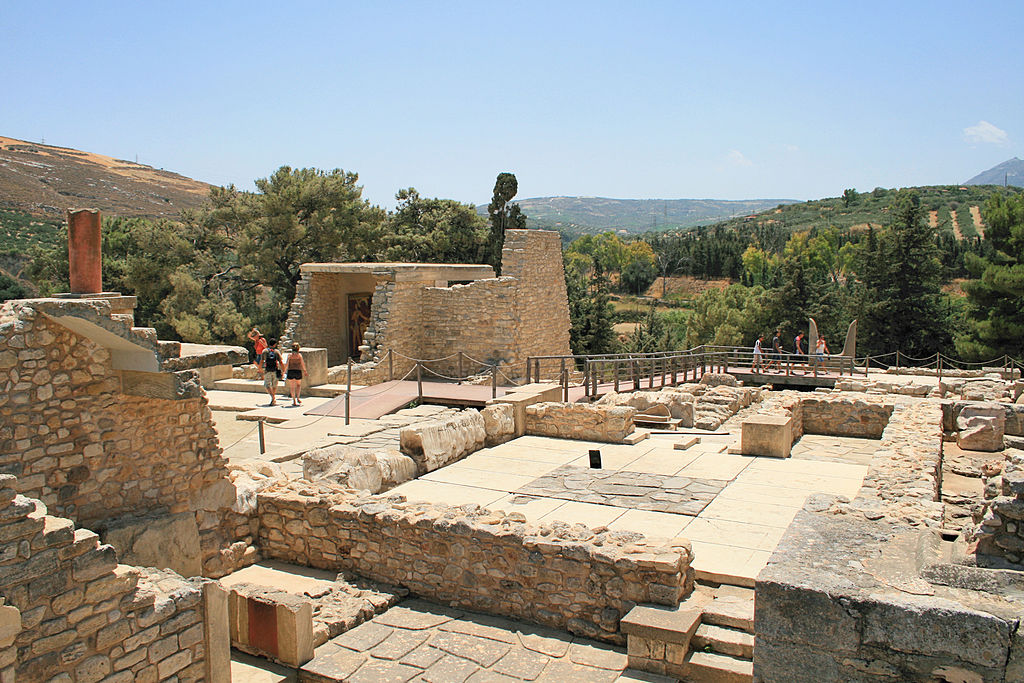
THE PALACE OF KNOSSOS


MINOAN ARTIFACTS AND PAINTINGS

Eventually I'll head back to Athens and then a lot of new adventures will take place. Among those I am hoping that I can do some book readings as the second volume of SHADOW OF THE LION is supposed to be published in October.
NOTE: photos of Paros and Irakleon from Wikipedia
Video: Yosemite Ranger Meets the True Owners of the National Parks
As we edge closer to the 100th anniversary celebration of the National Park Service later this week, this video gives us a good reminder about what those parks are all about. The clip, which comes our way courtesy of NBC News, introduces us to the true owners of these parks – the American people themselves. The national parks have been called "America's Best Idea" and for good reason. Prior to the designation of the world's first national park – Yellowstone – the idea of setting aside lands for the greater good of the public was completely unknown. Now, there are thousands of national parks around the world, with more being created on a regular basis.
MAKING TRIP PLANS, 2016
ENGLAND AND THE IONIAN ISLANDSI've started to verify and plan my trip to Europe this year which will begin September 4 when I fly to London. From there I will go right away to Caerphilly, Wales to spend a couple of days visiting with my cousins and touring my castle. It's a quick trip due to me having to take advantage of cheap air fares.

Caerphilly Castle


Windsor St. Where my Dad used to live.
On Sept. 7 I'll head into London again, early, in time to take in a special exhibit at the British Museum. I'm really excited about seeing EGYPT'S LOST WORLDS, which are artifacts found under the see, some off of Alexandria which was the city founded by Alexander the Great and occupied but the first Ptolemaic dynasty of Egypt.

The British Museum

Early the next morning I fly to Corfu, my first stop in the Ionian Islands off the west coast of Greece. I was only there briefly back in the early '80's so I wanted to spend a few days there as Corfu has an interesting history with lots to see. I've check out the tours and will try and take one of them so I can see as many of the special sites as possible. This will include the palace where Prince Philip was born and the home of the Durrell brothers of literary fame.

Corfu, Kerkyra

Mouse Island


Kerkyra
I'm staying on Corfu for 3 days then taking the quick ferry over to the tiny island of Paxis where I'll spend two days exploring. There are a couple of interesting museums and a Venetian Kastro on an islet off shore that was reputedly designed by Leonardo da Vinci.

Paxi, Gaia

Paxi harbour
From Paxi I must take a ferry to the mainland and then a bus to Lefkada where I'll head south to the town of Vassiliki (the surf-boarders paradise). Not sure yet if I'll spend a night there. It depends on the ferry service onward to Kefalonia where I will visit the seaside town of Fiscardo, established and named for a famous pirate.
From there I will head by bus to Athens, and will stop there to visit friends for a few days before heading on another island adventure, this time to the islands of Paros and Naxos. I decided to stay two days on Paros as it is another island that I've only visited briefly back in the '90's.
My favorite island is Naxos, so I'll stay there five days in a bed-tent at the Maragas Camping, a campsite and beach that I just love going to. I never get tired of visiting Naxos as it's a big island and lots to see besides having the most fabulous beaches! I can hardly wait to have my dinner at one of my favorite sea-side tavernas there to watch the sunset!
From Naxos I will head south to Crete. I haven't been to Crete since the '80's and wanted to see the Minoan site of Knossos again as well as exploring around Iraklion. I'll be there a couple of days and hope to get up to a mountainside resort owned by a FB friend.
When all my Cretan adventures are over, I head back to Athens and that's where I'll be for the month of October, until the 20th when I head back home. There's lots to see and do in my favorite city besides visiting with my friends. I'll go over to Salamina island for a few days to explore with Christina and probably make a few day trips around If finances enable it, I might even go up to Pelion for a few days as I've been wanting to explore that area for quite some time now.
Some of my Athens friends

Zoe and me

Carola, Christina and Kim
I'll be posting along the way and sharing all my adventures with on-line friends and family. So stay tuned for the next installment!
Video: Mountain Biking Jackson Hole, Wyoming
Jackson Hole, Wyoming is one of the truly great adventure destinations in the American west. Not only does it offer great skiing and snowboarding in the winter, there are plenty of trails to hike and ride during the rest of the year as well. In this video we travel to Jackson with pro mountain bikers Curtis Keene and Jared Graves where they discover some epic singletrack mixed in with the breathtaking scenery that this part of the country is so well known for. Enjoy the video, but be warned: You're probably going to want to ride these trails yourself.
Gear Closet: Altra Lone Peak 3.0 Hiking Shoes

This time out I was testing the new Altra Lone Peak 3.0 NeoShell Mid, a hybrid shoe of sorts that blends the best elements of a trail runner with a lightweight hiker. It features Altra's proprietary Foot Shape technology that allows for more room in the toe box for a more natural fit, and its Abound materials that allow energy to return to the foot when walking. They also have a zero-drop sole that allows both the forefoot and heel to strike the ground at the same time, which encourages better form throughout the length of your run or hike.
This being the "mid" version of the original Lone Peak shoe it comes with more ankle support built-in. This not only comes in handy when hiking demanding trails, it also gives the shoe a look that more resembles a hiking boot as well. Since I was using them more in that capacity rather than as trail runners, I appreciated the extra support, even on routes that weren't especially demanding.
When compared to other hiking shoes, the Lone Peak 3.0 Mid is extremely lightweight, tipping the scale at just 10 ounces (283 grams). That made them extremely easy to pack for my Canadian adventure, and helped to reduce fatigue when wearing them for extended periods of time, both on the trail and walking around town. In fact, I'd say that these shoes are more on par weight-wise with the trail running shoes I wear from other companies, rather than most hiking shoes. In other words, if you're in the market for a new pair of hikers and are looking to shave off some ounces, this just might be the shoe you've been looking for.
In terms of comfort, the Lone Peak feels more this a sneaker than a hiking shoe as well. They are very comfortable on your feet while still managing to provide a high level of support in all the areas you need it – most notably the arch, ankle, and footbed. I will say that my feet did get a bit warm at times thanks to the Polartech fabrics used in their construction, but not so much that they were actually uncomfortable. My feet tend to run warm most of the time anyway, so this wasn't completely surprising considering they were being worn on a summer hike.
The other important factor for a trail running or hiking shoe is traction on a variety of surfaces, and the Lone Peak doesn't disappoint here either. It uses Altra's new MaxTrac outsole and TrailClaw lugs to keep you sure footed even on rocks, mud, water, and fine dirt. I suspect they'd be fine on snow – and to a lesser extent ice – as well, although I haven't had the opportunity to test them in that environment just yet.
If there is one complaint I have about these shoes it is a minor one. They can be a bit tough to get on at first, as they have a narrow opening that can be difficult to slide your foot into without taking the laces out of the first few eyelets. The more I wore them however, the easier they were to get on my feet, in part because they started to loosen up some, and because I also learned the best way to get them into place. Still, I was put off by this at the beginning, so it is important to point out. Your first foray with these shoes may have similar results, so don't write them off based on that first impression.
That said, these are one of the more comfortable pairs of shoes that I've had the opportunity to try out in a long time. I really love the wide toe box that gives my feet plenty of room, and I appreciated the amount of cushioning and support that they provide too. On top of that, they are super versatile, transitioning from trail to town without missing a beat. I even wore them on a 35 mile bike ride and came away feeling great too. That makes them a nice set of footwear to have in your closet and a great choice for travelers too.
Priced at $160, these are the perfect shoes for fast packers, lightweight backpackers, trail runners looking for some extra ankle support, or hikers who just want a lightweight, yet durable option. Buy them now at CampSaver.
Subscribe to:
Posts (Atom)