Showing posts with label heritage buildings. Show all posts

Tuesday, November 18, 2014

ENGLAND 2014: A FEW DAYS IN LONDON

I always love visiting London. When I first arrived there Sept 1, I stayed at my favorite place, the Indian YMCA, a centrally located, reasonably priced hostel-type hotel near Warren Station.  I always enjoy browsing the area. Right across the square is the former home of Virginia Woolf and various other members of the Bloomsbury Group of writers also lived in that area.  Just down the street is the Fitzroy Tavern where writes such as Dylan Thomas hung out while in London. Naturally, I like to stop in there just for the writerly atmosphere.
 
Dylan Thomas and Others

George Orwell

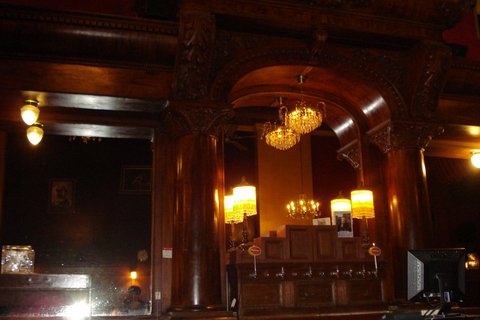
The well-stocked bar


The Fitzroy Tavern, London

My main purpose for spending time in London on this trip was to attend the Historical Novel Writer's Conference (Sept 5,6). So after my 3 days visit in Wales, I returned to London and took up residence in a student dorm at the International House in Waterloo,  on London's south side (across the river). It was conveniently located near a tube station in order for me to reach the conference which was at the Marlybone Campus of the University of Westminster.


 Statue of Sherlock Holmes across from the University
 
I went to the meet-and-greet and registration of the first day (Sept 5) and enjoy myself meeting lots of other historical writers. My biggest thrill that day was running into renown writer Margaret George, whose work I admire. I had spoken to her at the Surrey International Writer's Conference two years ago when I attended one of her workshops, and I'd explained my concern over the length of SHADOW OF THE LION.  She had told me "Just don't worry about the length. Keep on writing!" Imagine her surprise (and delight) when I told her that I'd listened to her and now I had a two-book contract, with volume one already published. 

That evening we went for a dinner at a nearby restaurant for the Hardy's Historical supper  and enjoy some good food, wine and camaraderie with a group of the writers.


The next day I attended the all-day sessions of various workshops. And I made sure I went to one that Margaret George was participating in.  I also enjoy hearing from  the keynote speakers and a couple of other presenters who were successful historical fiction writers.  I met one of the writers from Oxford who is a good friend of Robin Lane Fox whose book about Alexander the Great I referred to for some of my research for SHADOW.


My last day in London I chose to go on a London Walk. I love these walks and this time decided on the Dickens & Shakespeare Walk.  The American professor who was our guide proved to be entertaining as well as informative. 


We strolled around all the parts of town where Dickens was inspired to write several of his books such as "Pickwick Papers" and "Great Expectation."


We also visited the district near the Jewish Quarter where Shakespeare lived with a Huguenot family and penned many of his famous dramas.  There is a memorial to him and a plaque to his two friends who 'rescued' Shakespeare's folios after his death and saw that they were published. Otherwise we might not have had the privilege to enjoy his work.

 
Monument to William Shakespeare
 

Guildhall
 

Smithfields Market


We also toured the noted areas of that time, such as the Guildhall (from the 1400s) the Smithfieds Market that had signs depicting the cruel punishments meted out of people those days, the place nearby where William Wallace (Braveheart) was slaughtered as well a number of other fascinating old London sites.


After the walk, which took about 2 hours (or longer) I went to see St. Paul's Cathedral. By that time I was tired from the walking and headed back to the Indian Y where I had chosen to stay for my last night in London.  The next day, I headed out to Heathrow for my flight to Greece. 


NEXT: GREECE: My first stop: THESSALONIKI.

Sunday, September 22, 2013

VISITING THE DELLA ROCCA BAROZZI VENETIAN TOWER MUSUEM, NAXOS

Add to Technorati FavoritesThis summer when I spent a few days on my favorite island, Naxos, my BC friends Glenys and Marnie and I went exploring around Naxos old town, the Venetian quarter. This is where, in Venetian times, the wealthy lived within or surrounding the walls of the fortress, called the "Kastro".  From 1294 ti 1537 this was the stronghold of the Venetian Duchy of the Aegean.
Venetian tower house
Within the Kastro there are still remains of some original buildings including the Catholic cathedral. Right behind it is the French School of Commerce opened by the Jesuits in 1627. The renown Cretan writer, Nikos Kazantzakis, once attended here. Now it houses the Archaeological Museum. There is also the Ursuline Convent and School where the young ladies of Venetian aristocracy were educated.
Surrounding the Kastro there are still several of the tower homes once occupied by Venetian gentry. One of these is the Della Rocca Barozzi home, which the owners still occupy some of the year.  But during tourist season, this is the Venetian Folklore Museum. http://www.greeka.com/cyclades/naxos/naxos-museums/naxos-venetian-museum.htm

I've always wanted to visit the museum and somehow, despite my many trips to Naxos, this was the first time I made a point of going in. Only two of the Kastros original seven towers remain. A few of the Venetian Catholic's descendants still live in the old mansions encircling the site. Their family coats of arms decorate the doorways. It's fortunate that the Della Rocca family decided to turn their home into a museum, giving people an opportunity to view what life was like in the days of the Venetian Duchy.


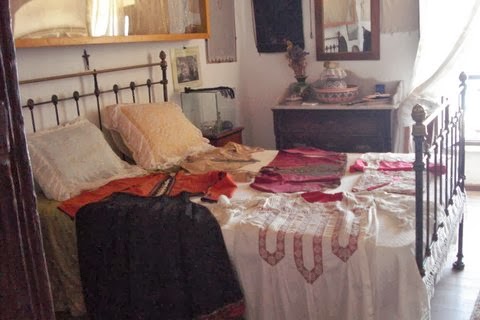
The museum is located near the entrance of the castle, called Trani Porta. Here you have a chance to see objects and furnishing of an old household that tells some of the history and tradition of Naxos. You step inside and feel as if you've gone back in time to the 13th century. Rooms are filled with ornate furniture, elaborate rugs, household items, clothing, tables set as if dinner guests will arrive at any minute, comfortable bedrooms including a nursery, all decked out with the filmy trappings and objects of a lady's boudoir. In the living room area, there's an old piano once played by Leonard Bernstein. Marnie got a chance to sit down and tinkle out a few tunes.

Marnie plays us a tune
 

 View from a tower window

If you're lucky, perhaps the owner will be there to guide you through. Otherwise there are tours in English by docents.  The tour ends up in the wine cellar which has even more objects dating back well into ancient times including a stone engraved with a message to Ptolemy of Egypt.

 
Ancient engraving addressed to Ptolemy of Egypt

Glenys enters the wine cellar
 
The museum is open daily from April to October (10 am - 3 pm and 7 pm to 10 pm) with an entrance fee of 5 euro (3 euro for students). During the summer season, the museum holds cultural activities such as music concerts (classical and jazz, local and traditional music) art exhibitions and folkloric events. http://www.naxosfestival.com These are held in the tower garden with spectacular views overlooking the harbour and the famous "portals" at the entrance to the harbour, the unfinished portal of a temple of Apollo built around 530 BC.


We had a wonderful morning touring the museum, and browsing the shops along the narrow vaulted streets nearby, ending up with a delicious lunch at a hillside taverna overlooking the port.


Glenys and Marnie enjoying a delicious lunch overlooking Naxos harbour


Friday, December 7, 2012

EXPERIENCING SEATTLE

Add to Technorati FavoritesThis is the last part of my Seattle Adventure with a few more photos and stories about what I saw and did on my two-day visit there.

Seattle Washington is a neighbour city of Vancouver but although I've often passed through, sometimes spent a few hours browsing or shopping, I've never actually stayed any length of time. I went down on a Friday evening on the Greyhound and returned on the Sunday evening so it gave me a fair amount of time to sight-see.  My main purpose had been to see the King Tut Exhibit at the Pacific Science Center and also to browse around the Pike's Market.  It turned out my lovely five star hotel was centrally located so I could walk to many of the places I'd come to see and a short cab ride to others.
Mural honoring the First Nations people of Seattle

Seattle is a major coastal seaport located on Puget Sound. The name, "Seattle" comes from an Indian chief whose people once occupied that territory.  The city has around 620,778 residents (as of 2011) and is the largest city on the West Coast north of San Francisco.  Metropolitan Seattle has over 3.5 million population.  Back in the early days it was a logging town but by the late 19th century it was a commercial and shipbuilding center and a gateway to Alaska during the Klondike Gold Rush.

By the early 1900's the city was booming and it was one of the largest cities in the country. In 1913 firearm and typewriter magnate Lyman Cornelius Smith built a 489 ft. tower, at the time the tallest building west of the Mississippi. The thirty-eight storey building remained the tallest building on the West Coast until the Space Needle was built in 1962.

Smith Tower

I enjoyed a tour through the Seattle Underground and the historic area around Pioneer Square where there's many heritage buildings. You'll see the old along with the new in Seattle making it an interesting city-scape.

Buildings near Pioneer Square with modern sky-scraper
 
Seattle has an interesting musical history too. From 1918 to 1951 there were nearly two dozen jazz clubs. The early careers of jazz greats like Ray Charles and Quincy Jones were developed here. Rock legend Jimi Hendrix was born in Seattle. "Grunge" music was made famous there by groups like Nirvana and Pearl Jam. In recent years it's known for indie rock. 
 
I found a cozy jazz/blues bar walking distance from my hotel.  The New Orleans Restaurant at Pioneer Square had a friendly atmosphere and I didn't mind going in for the evening though I was alone. I enjoyed the ambiance and felt right at home.

That night there was a Blues band, Gin Creek, playing — four guys and a woman vocalist.  I took in a couple of sets then meandered back to my hotel.  There'd be lots more adventures the next day.
Gin Creek

 
My friend Taryn came to meet me the next morning and we set off on another adventure. First we walking through town and took in some of the street sights.
Interesting shops around Pike's Market
 
Street Mime
 
Then we flagged a cab and set off for Seattle Center. There's lots to see and do a Seattle Centre - 74 acres of events, plaza, parks and museum. We headed first to the Pacific Science Center to see the King Tut Exhibit.  After that we walked over to the Space Needle, intending to take the elevator to the restaurant at the top. Alas! We needed reservations so had to pass up the opportunity.
 
Space Needle
 
I hadn't seen the Space Needle since 1962 when it was first built for an Expo. We had stopped by with the kids on our way to California for vacation. It would have been fun to ride to the top but that will be on the list for my next visit.
 
Right next to the Space Needle is the unique Chihuly Garden and Glass museum exhibit. I took some photos of the unusual trees all made of glass that were visible above the fence. If we'd had more time we would have gone in for a closer look. But, it will be on my next visitor's list too.
Chihuly Garden and Glass
 
 
You can read about my luxury hotel stay, Pikes Market, Miner's Wharf, Pioneer Square and the Seattle Underground  and the King Tut Exhibit at Pacific Science Centre in my separate blogs.
 
IF YOU GO: Here's some links to help you plan your weekend trip to Seattle.


Thursday, November 15, 2012

EXPLORING SEATTLE'S UNDERGROUND

The pergola, Pioneer Square

Down under the streets of Seattle near Pioneer Square, as we wander through a warren of tunnels an amusing and informative guide tells us of the city's early history. In the mid 19th century these 'streets' and passageways were ground level but after the streets were elevated they fell into disuse and are now a major tourist attraction. Pioneer Square is the city's oldest neighborhood.  The lovely wrought-iron pergoa was built in 1909 and underground there was a fancy bathroom which is now closed since the Seattle earthquake a few years ago. The term "Skid Row" was coined to describe the Square where huge logs shoved from the highlands west of town skidded downhill to the waterfront. There is a memorial at the Square for Chief Seattle whose people once lived on that land.

Chief Seattle
 
Totem
 
The tour groups meet in an old bar at the coffeeshop and ticket office of the Underground Tours. A guide tells the history of the city in a most entertaining way, preparing us for the tour.  Then we are divided into small groups and assigned another guide for our adventure under the streets of the city.

The old bar room
 
Entrance to the underground
 
When Seattle was first built up in the 1800's all the buildings were wooden. On June 6, 1889 a fire was accidentally ignited by an overturned glue pot and the fire bread so rapidly the core of the city was destroyed. To insure against a similar disaster, in future all streets had to be graded and new buildings had to be of stone or brick and only one to two stories high.
Touring the underground
 
 
Pioneer Square had been built on land-fill in the tideland's and as a consequence it often flooded. Flush toilets had to be installed that funnelled into Elliott Bay and made so that sewage didn't back up at high tide as it had before. When the new buildings were constructed, the ground floor would eventually be underground and the next floor up,was the new ground floor.


Brick arches provided the ceiling for the underground corridors and supported the sidewalks above. Streets were lined with concrete walls forming narrow alleyways between the walls and buildings.  Pedestrians had to climb ladders to go between street levels and the sidewalks in front of the building entrances. Skylights with small panes of clear glass were installed creating the area now known as the Seattle Underground.
Skylights


Toilet
 
The Underground was condemned in 1907 for fear of bubonic plague. The basements were left to deteriorate or were used as storage. Some became flophouses of the homeless, speakeasies and opium dens.

In 1965 a local citizen, Bill Speidel, established "Bill Speidel's Underground Tour", realizing there might be an interest in the underground ruins. Over the years this tour has become more popular and the underground structures have been refurbished.

Items in the Underground Museum
Printing press and typewriter
 
Copy of the original "Crapper" (named for the man who invented the first flush toilet)


There is also an adults-only Underworld Tour.  At one census report at the turn of the century there were reportedly 10,000 loggers living in Seattle and 2500 'seamstresses'.  These women, were of course prostitutes.  The most famous Madam in Seattle was Lou Graham. She had a bevy of 'seamstreses' working out of her house and ran a money-lending operation as well.  When she died in the early 1900s she bequeathed all her money to the Seattle school board.
Madam Graham is on the left and her four favorite girls (the prize one is in black)
In the Underground Museum you'll see a photo of Madam Graham and four of her most popular girls. There's a secret to this photo:  the one dressed in black was the most popular of the girls but clients had to know that in order to choose her for her special services.


Lou Graham's house of ill repute at Washington and 3rd Ave.

IF YOU GO:
The daily tours start on the hour from Pioneer Square, from 10 -7  May- Sept and 11 - 6 Oct-April.
The Underworld Tours is daily May - Sept 8 & 9 pm and October-April Thursday-Sat. at 7 & 8 pm.
608 First Avenue. Tickets at www.undergroundtour.com  or at the Underground Tour meeting place.

NEXT: The Pacific Science Centre and The Wonders of King Tut's Tomb.