Showing posts with label exhibits. Show all posts

Friday, November 13, 2015

A VISIT TO ‘MY’ CASTLE, CAERPHILLY WALES


Caerphilly Castle

Every time I visit my dad’s home in Caerphilly Wales, I spend at least a day ‘inspecting’ my castle. If you wonder why I’ve laid claim to this famous castle, built back in 1271 by the English chieftain Earl Gilbert de Clare, it’s because I grew up hearing stories from Dad who used to play inside it when he was a boy. From the first time I actually saw the castle back in the mid ‘70’s up until now, I feel I ‘own’ a piece of it and thus I have chosen to refer to it as my castle!


Earl Gilbert de Clare’s castle was besieged by Llewelyn, Prince of Wales, back in the late 1200s and Henry III stepped in to enforce a truce after which Earl Gilbert regained possession of the castle.


It was again attacked in 1316 during a revolt by another Welsh lord, Llewelyn Bren. During the 15th century it fell into decay and it wasn’t until 1929 that it was restored by the Marquises of Bute. It’s one of the best preserved castles in Wales and is now protected by the Department of Environment.


The castle has many stories to tell.  In one big room there is a tapestry hanging on the wall depicting three women who were noted inhabitants.  The first is Alice de Lusignon (1236-1290) the first wife of Gilbert de Clare. As he was away at war much of the time, the lonely queen found comfort in the arms of a local knight. When Gilbert found out he had the knight hanged and annulled his marriage to Alice. In despair she left off the castle walls. It is her ghost who is said to haunt the castle.

I published a story about this famous myths, the Green Lady, a tale that has intrigued me since I first began to visit Caerphilly castle. I’m always aware of her apparition each time I go, watch for her on the walls on a moonlit night, ‘feel’ her presence as I wander the narrow stone passageways and enter the big empty palace rooms.


 The second woman is Joan of Acre (1272-1307) daughter of Edward 1 who became Gilbert de Clares wife in 1290. After bearing him four children, Gilbert died so her father arranged a second marriage but against his wishes she married a commoner, a knight named Ralph de Monthermen who later the king grew to like and accepted the marriage.


Eleanor de Clareis the third woman pictured in the tapestry (1292-1337). She was the daughter of Gilbert and Joan. After Gilbert died the castle was bequeathed to his 3 sons but while they were away the castle was besieged by Llewelyn Bren and under Eleanor’s it was successful held out til help arrived. She also survived an unhappy marriage to a dangerous and disliked husband and an imprisonment in the Tower of London.


As you stroll around the long passages and up the winding stairways you’ll see different displays and art work telling the castle’s history. And out front, beside the moat there is an interesting display of siege equipment. 

Wednesday, November 6, 2013

EXPLORING EVVIA (EUBOEIA)

Add to Technorati Favorites

Last summer when I was visiting Greece, a friend invited me to go on a bus 'exploration' trip with a group of Greek seniors from Athens. The trip would take us across to Evvia (by the bridge to Halkida) and up over the mountains to the eastern side of the island.  Evvia is the big island that is very near the west coast of Attika.  I used to live part time in a tiny shepherd's village up in the mountain near Karystos in the south, but other than one long-ago visit to Halkida  on my very first New Years in Greece, I'd never explored the rest of the island.
Nea Artaki
 
It's a pleasant bus ride from Athens and over the new bridge to Halkida, Our first stop was Nea Artaki, a pleasant sea-side town where we stopped for refreshments.  Then we traveled north-east through various small towns and remote villages. 


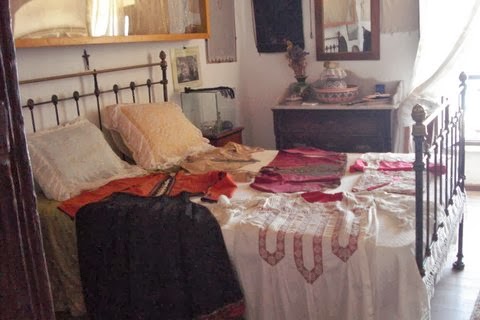
We ventured farther north and eastward through dramatic mountain scenery, through the towns of Psaxna and Kontodespoti where we stopped to visit an interesting folk museum and a beautiful old Byzantine church.


Folk Museum


 Pappas relax in front of church


From there the bus climbed higher into the mountains and the scenery became more dramatic. The narrow road twisted up steep mountainsides with deep gorges where you got amazing vistas of the valleys below. There were lots of scary twists and turns and heart-stopping moments. In one word, "Breathtaking!"


 Apiary (beehives)


"The reason they call these trips explorations", my friend told me, "is because they go to places most tourists don't go."  Sometimes these are to remote places that are like safaris into the unknown parts of the country." 

We intended to stop at a monastery high up in the hills but it was closed.  So we continued on and wound our way down the serpentine narrow highway to a small beach resort called Limonomos where we had a four hour break to rest.  The beach was sandy and the water warm so we had a refreshing swim and a huge tasty lunch at the taverna.


 Carol tries out a swing chair
 

On the return trip, we stopped at Halkidi to look at the swirling current of the Euripos Channel, a tidal bore where the philosopher/scientist Aristotle once threw himself in to see if he could figure out what caused it.  Since then lots of other scientists have tried to explain this phenomena.


 Tidal bore at Halkida


It really was an exciting day 'exploring' Evvia and a chance to see some of the beautiful island countryside. We were the only English speaking guests on the tour other than the tour guide but we enjoyed every minute of it.  All for 25 Euro.  A pretty good deal for a day tour! 

Tuesday, October 22, 2013

FINDING SOME COIN TREASURES AT THE HEINRICH SCHLIEMANN HOUSE, ATHENS

Add to Technorati Favorites
The Heinrich Schliemann House (Numismatic Museum, Athens
 
As long as I lived and have visited Greece, which has been since 1979, I never once went inside the Heinrich Schliemann house, although many times I have stopped on the sidewalk to admire the painted porch. But this past summer, I happened to stroll into the garden area, seeing that the front gate was open, and I discovered that on Thursday evenings there was music in the garden. This piqued my interest, so I invited a couple of friends and we went to enjoy a relaxing evening.

 
The Garden of the Muses was part of the Schliemann's estate but now it is a pleasant outdoor cafe. That night there was Brazilian music playing, a real treat as I sat and sipped a cold sangria and ate some mezes.


Heinrich Schliemann was the man who discovered the treasures of Troy and Mycenae, some of which are exhibited in the National Archaeological Museum of Athens. The house was built by the famous German architect Ernst Ziller and completed in 1881. It has an Italian Renaissance style later adapted to the late 19th century neoclassicism. It was one of the most elegant houses in Athens.
 
 
I was curious to see what was inside the house, so returned a few days later to take a look.  From the moment I climbed the marble staircase to enter the front door, I was amazed at the fantastic decor of the house, which now houses the Numismatic Museum. Inside, the walls and ceilings depict scenes copied from Pompeii.  The mosaic floors were inspired by Schliemann's excavations of Mycenae.
 
Interior decor
 
Entrance hall
 
Mosaic floor
 
 
The rooms are now displays of the thousands of gold and silver coins collected or donated to the museum. This museum is unique in Greece and one of the most significant of its kind in the world. It has over 500,000 objects, coins, lead seals, weight,s medals and gems dating from the 14th century BC to the present time.


 I was completely delighted to find gold staters from the time of Philip I of Macedonia and his famous son Alexander the Great.  And I even found a silver tetradrachma exactly like the ring I wear.
There were also gold drachmae issued at the time of several of Alexander's successors such as Ptolemy and Lysimachos.  Of course this interested me because of my novel SHADOW OF THE LION and all the research I had done. 

I'm glad I took the time to stop and visit inside the Schliemann House.  The Museum is open Tuesday - Sunday from 8.30 am - 3.30 pm. The entrance fee is just 3 Euro (1 Euro less for seniors and students) and there are some special days that are free.  It's located at 12 El. Venizelou (Panapistomiou Ave.) not far from Syntagma Square.  Music in the garden is held during the summer months on Thursdays.   www.nma.gr

You can read a more complete story about my visit to Schliemann's House at
http://www.europeupclose.com/article/heinrich-schliemanns-house-in-athens/ 


Sunday, September 22, 2013

VISITING THE DELLA ROCCA BAROZZI VENETIAN TOWER MUSUEM, NAXOS

Add to Technorati FavoritesThis summer when I spent a few days on my favorite island, Naxos, my BC friends Glenys and Marnie and I went exploring around Naxos old town, the Venetian quarter. This is where, in Venetian times, the wealthy lived within or surrounding the walls of the fortress, called the "Kastro".  From 1294 ti 1537 this was the stronghold of the Venetian Duchy of the Aegean.
Venetian tower house
Within the Kastro there are still remains of some original buildings including the Catholic cathedral. Right behind it is the French School of Commerce opened by the Jesuits in 1627. The renown Cretan writer, Nikos Kazantzakis, once attended here. Now it houses the Archaeological Museum. There is also the Ursuline Convent and School where the young ladies of Venetian aristocracy were educated.
Surrounding the Kastro there are still several of the tower homes once occupied by Venetian gentry. One of these is the Della Rocca Barozzi home, which the owners still occupy some of the year.  But during tourist season, this is the Venetian Folklore Museum. http://www.greeka.com/cyclades/naxos/naxos-museums/naxos-venetian-museum.htm

I've always wanted to visit the museum and somehow, despite my many trips to Naxos, this was the first time I made a point of going in. Only two of the Kastros original seven towers remain. A few of the Venetian Catholic's descendants still live in the old mansions encircling the site. Their family coats of arms decorate the doorways. It's fortunate that the Della Rocca family decided to turn their home into a museum, giving people an opportunity to view what life was like in the days of the Venetian Duchy.


The museum is located near the entrance of the castle, called Trani Porta. Here you have a chance to see objects and furnishing of an old household that tells some of the history and tradition of Naxos. You step inside and feel as if you've gone back in time to the 13th century. Rooms are filled with ornate furniture, elaborate rugs, household items, clothing, tables set as if dinner guests will arrive at any minute, comfortable bedrooms including a nursery, all decked out with the filmy trappings and objects of a lady's boudoir. In the living room area, there's an old piano once played by Leonard Bernstein. Marnie got a chance to sit down and tinkle out a few tunes.

Marnie plays us a tune
 

 View from a tower window

If you're lucky, perhaps the owner will be there to guide you through. Otherwise there are tours in English by docents.  The tour ends up in the wine cellar which has even more objects dating back well into ancient times including a stone engraved with a message to Ptolemy of Egypt.

 
Ancient engraving addressed to Ptolemy of Egypt

Glenys enters the wine cellar
 
The museum is open daily from April to October (10 am - 3 pm and 7 pm to 10 pm) with an entrance fee of 5 euro (3 euro for students). During the summer season, the museum holds cultural activities such as music concerts (classical and jazz, local and traditional music) art exhibitions and folkloric events. http://www.naxosfestival.com These are held in the tower garden with spectacular views overlooking the harbour and the famous "portals" at the entrance to the harbour, the unfinished portal of a temple of Apollo built around 530 BC.


We had a wonderful morning touring the museum, and browsing the shops along the narrow vaulted streets nearby, ending up with a delicious lunch at a hillside taverna overlooking the port.


Glenys and Marnie enjoying a delicious lunch overlooking Naxos harbour