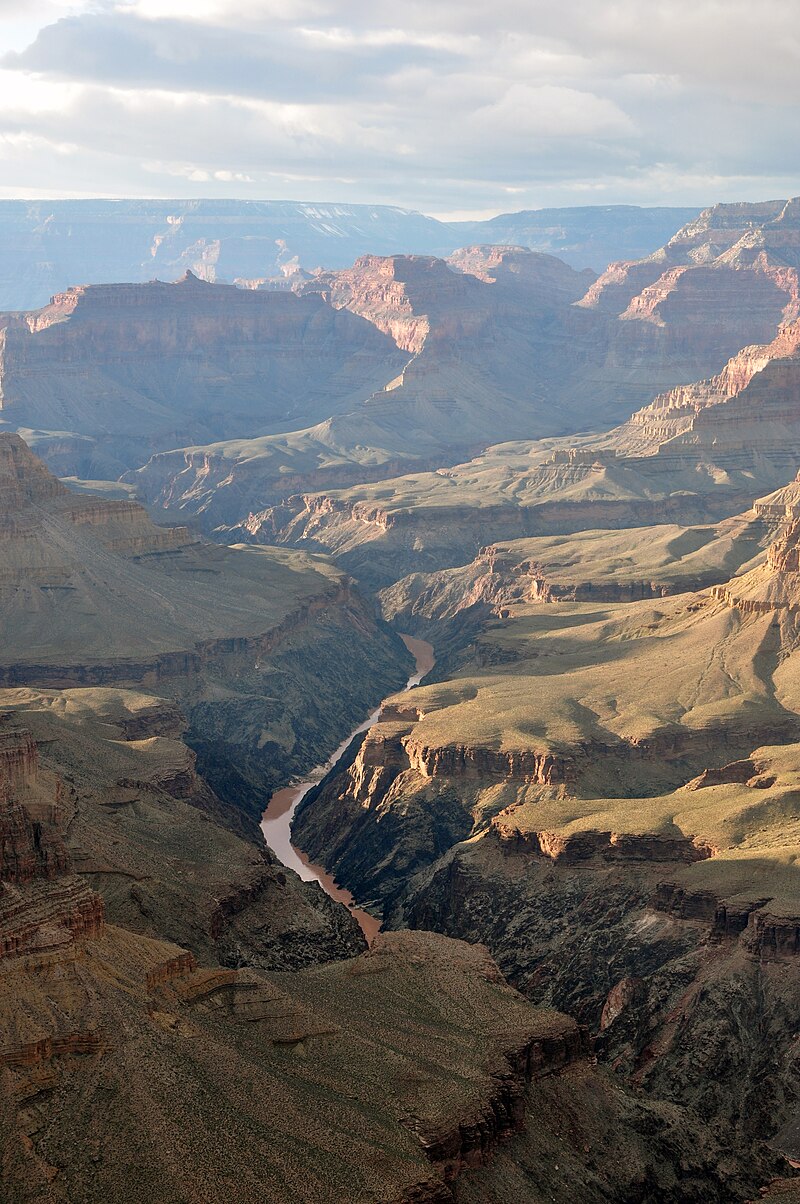
Yesterday I posted a beautiful video of the Grand Canyon in celebration of the 100th anniversary of the National Park Service later this week. Everyone knows that the national park is one of the most iconic outdoor destinations in the entire world, with some of the most amazing opportunities for adventure. But are we losing the Grand Canyon to commercial and industrial development? That is the question posed in a new article from National Geographic that reveals an uncertain future for one of the U.S.'s most famous landscapes.
In order to explore the threats to the Grand Canyon, journalists Kevin Fedarko and Pete McBride have spent the better part of the past year exploring its wonders. Starting last fall, the two men have trekked for more than 650 miles (1046 km) through remote wilderness to not only get to understand the Canyon better, but to discover how its fragile ecosystem has increasingly become under siege by outside interests.
Along the way, they talked with people living in and around the park as the two men learned about the potential for over development and the increased stress put on the Grand Canyon due to a larger number of tourists visiting. But most importantly, they discovered that mining operations just outside the park's borders could have a long-lasting, and incredibly devastating, impact on the park itself, creating a potentially dangerous environmental catastrophe. For example, uranium is one of the substances that is mined near the park that could have severe impact on its future. In fact, U.S. Geological Survey data says that 15 springs and five wells near the Grand Canyon already have levels of uranium that are considered unsafe to drink. This is mostly due to incidents from older mines in the area, but it underscores the problem none the less.
While the story is already quite eye-opening, Fedarko and McBride aren't quite done yet. They're continuing to explore the Grand Canyon even now, with plans to wrap up their investigative expedition sometime in October. The story is of course still unfolding, but the hope is that we're not too late in spreading the word about the threats to this incredibly popular national park. After all, it is a place that has been presumably preserved for future generations to enjoy as well, so why would we want to spoil it now? Hopefully that won't happen.
Showing posts with label Environmental. Show all posts
Tuesday, August 23, 2016
Tuesday, July 26, 2016
Solar Impulse Completes Round-The-World Flight
Solar Impulse, the innovative aircraft powered only by the rays of the sun, completed its historic flight yesterday by landing back in Abu Dhabi, the city from which it departed from back on March 9 of 2015. In doing so, the solar-powered plane became the first to circumnavigate the globe without the use of any form of fossil fuels.
The entire journey was broken down into 17-stages that covered a distance of more than 42,000 km (26,000 miles). The flight path crossed four continents, three seas, and two oceans, beginning and ending in the United Arab Emirates. The longest leg of the expedition took place between Nagoya, Japan and Hawaii, covering some 8924 km (5545 miles) of Pacific Ocean in the process. That stage alone took 118 hours to complete, giving pilot Andre Borschberg the record for the longest solo flight.
Throughout the flight Borschberg split time at the controls with fellow pilot Bertrand Piccard, who was at the helm of the Solar Impulse when it made the final flight from Cairo, Egypt to Abu Dhabi yesterday, bringing an end to the 17-month odyssey that proved clean energy can be used to power an aircraft. The two pilots has hoped to complete the journey in a much shorter timeframe however, but a catastrophic failure of the aircraft's battery system caused it to be grounded for 10 months while repairs and upgrades were made.
The Solar Impulse has a wingspan of over 72 meters (236 ft), which is larger than even a 747 commercial aircraft. Those wings contain more than 17,000 individual solar cells, which collect power and store it in onboard batteries. Those batteries can than be used to power the aircraft even at night.
While this was an impressive demonstration of technology and the steps being taken to improve the use of clean energy, don't expect the Solar Impulse to have a dramatic impact on the commercial aviation anytime soon. Solar cells will need to improve their efficiency drastically before that can happen, as it is currently impossible to power a large aircraft using just the light of the sun. Still, this is a step in the right direction, show us a potential future where clean aircraft could whisk passengers off to remote destinations without having a dramatic impact on the environment. While that vision is still in the distant future, it is good to know that we're taking small steps towards making it a reality now.
Subscribe to:
Posts (Atom)
