Tuesday, June 24, 2014

EXPLORING THE NIGHT LIFE OF HURGHADA


The evening after we arrived at the posh Kempinski Hotel at Soma Bay,  Markos suggested we should go into the nearby city of Hurghada to have a look around.  Hurghada is the area’s best known resort area with lots of dive shops and other amenities. This was a kind of ‘secret’ get-away so only Linda, Markos and I set off by van for the 45 km drive north of the Soma Bay Resorts. The others had gone for a long spa treatment, which I had turned down in favor of the Hurghada adventure because I knew I’d be too tired. Yves was, and that’s why he didn’t accompany us.


Hurgada started out as a small fishing village but because of the investments made along the Red Sea coast it has become a busy town with lots of watersports and nightlife.  The hot, dry climate make it popular with Europeans who often spend their holidays there. Today Hurghada has 248,000 inhabitants.
We were met in the town by a tourist rep who escorted us on a walking tour down Hurghada’s busy main street.  Just as in other Mediterranean resorts the town comes alive at night when things have cooled down a bit.  There were plenty of people on the streets including families with children. 
 
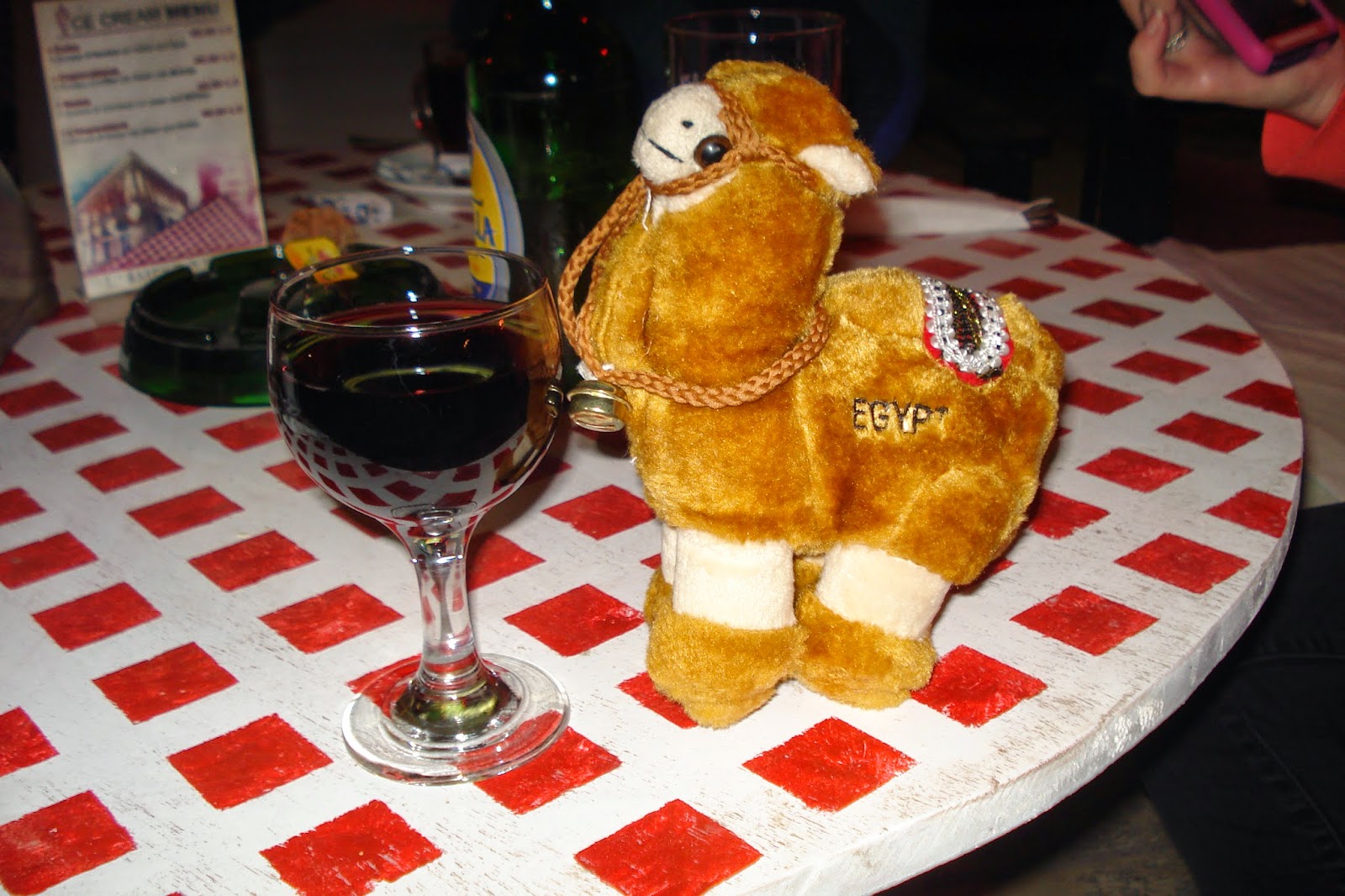
The main street has a variety of shops. Linda and I bought some souvenirs in one shop and that’s where I met my little mascot, Abdul the Camel.  I couldn’t resist him and from that evening on he accompanied me on all my Egyptian adventures. 


Meet Abdul the Camel


There is a busy yacht harbour along the sea and an amusement park area.  But what intrigued me most were the little cafes, some of them resembling tents with people sitting on comfy chairs and couches around low tables. 


We found one that was an Italian cafe, and I ordered lasagna that was one of the best I’ve ever tasted with a little tomato on top carved like a rose.
 
  Markos ordered a shisha pipe and we sat under the canopy smoking apple-flavored tobacco, as we sipped Egyptian wine and  dined on our delicious meal. That was one of the most fun evenings, just the three of us and the tour guide enjoying some leisure time together.  

Linda, me and Markos having fun! 


NEXT:  Another Spa Tour and the Red Coral Reefs  


Thursday, June 12, 2014

HAVE I DIED AND GONE TO SHANGRI-LA? THREE LUXURIOUS DAYS BY THE RED SEA


No kidding! I thought I’d died and gone to Shangri-la when we drove out of the desert and entered the exotic and luxurious Kempinski Hotel at Soma Bay on the Red Sea.  For a traveler like me who usually goes budget, even back-packs and camps, this sprawling Moorish style hotel-spa was like waking in a fairy-tale dream.  The hotel occupies a beachside area spanning 150,000 sq meters offering 325 rooms designer furnished with views overlooking the hotel lagoon and creation pools to the sparkling turquoise water of the sea.
As I surveyed the luscious landscape, the waterfalls, streams, heated swimming pools and the long stretch of beach I could only gasp and say “Wow!”  No wonder the Kempinski is known as the Pearl of the Red Sea!


Welcome to My Room!

 
After our long journey across the desert, I could hardly wait to go for a swim so I donned my bathing suit and headed for the beach.  Imagine! A chance to swim in the Red Sea (called that name because of the red coral reefs), a sea that I had long-ago heard about in Bible stories. I envisioned myself drifting in the crystal clear water. 

I started to wade out and went farther and farther from shore, the water barely reaching my shins!  Now I know how Moses led the Israelites out of Egypt across the sea. They waded across! Finally I squatted down so it appeared that I was submerged and had my friend Linda take my photograph, just so I could say I ‘swam’ in the Red Sea.

 
Wading in the Red Sea
 

Pretending to Swim


 Camels on the Beach


Then I returned to shore and joined my friends by the pool side.  It is such a large pool it was almost like swimming in the sea so I spent the rest of the afternoon splashing around and lolling in the sun by pool-side.
 

There’s pool-side restaurant, Al Mar, where sunbathers can order snacks or drinks.  The hotel’s main restaurant is The View where we were served a spectacular buffet dinner later that day.


Some of the Luxurious Surroundings 


 It was fun just hanging out in the vast and beautifully decorated main lounge area where we lounged on comfy couches and checked our emails on our iphones and tablets.


 In the evening Markos, Linda and I sat outside on the patio, ordered glasses of Egyptian wine (my favorite was the Omar Khayyam) and smoked a water pipe of pear flavored sheesah. This is a very communal type of pastime in Egypt, relaxing and sweet-tasting and not a narcotic smoked from a tall ornate pipe with long tubes for inhaling. Even a non-smoker like me enjoyed puffing away as we chatted and watched the glorious rosy sunset over the sea.


The Soma Bay Peninsula is 10 square miles but only 2 miles are developed. The Kempinski Hotel is one of several luxurious spa-resorts on the shores of Soma Bay.  Just down the beach we visited the Residence Des Cascade Resort, another spa hotel.   


We were taken around the 18 hole championship golf-course on a golf cart. This would appeal to most golfers, a par 72 course right by the sea the lush green fairways a contrast to the distant desert landscape. 


Later we stopped at the Breakers Hotel, designed for the more laid-back adventurous folks. There’s a dive centre and  a Kite House offering  kite surfing and kite racing on the long stretch of beach.  We watched dozens of brightly coloured kite-surfers, like giant butterflies, hovering over the water. You can take a 4 day kite-surfing course as well as learn how to scuba dive at the Dive Centre. There is also a volley ball training court.


 Nearby is the Soma Bay Thalasso & Spa, said to be the best spa in Egypt and one of the largest in the world. It has 65 treatments rooms offering everything from traditional massages and beauty treatments to the latest in aesthetic treatments and hydrotherapy administered by highly trained therapists.  It’s located at the Cascades Hotel but is available to guests in the entire Soma Bay area. 


 We were invited to return for a free spa treatment.  But Markos, Linda and I had other plans: a night out in the nearby city of Hurghada. I knew I’d be too tired to enjoy the fun if I went to the spa, so I passed up the chance.  Good job too, because Yves was too tired to join us as we set off by van for a night of adventure in the city.

http://www.residencedescascades.com/


NEXT:  Exploring the Night-life of Hurghada.

Sunday, May 25, 2014

LUXOR TO THE RED SEA: A DESERT EXCURSION


I’ve always been curious about the desert so when I learned we would drive from Luxor to Soma Bay on the Red Sea, a distance of about 327 kilometers, I was excited at the opportunity to experience the Sahara first-hand. I’d seen the desert in movies but this would be the real thing.


The Sahara is the world’s hottest desert, over 9,4000,000 square kilometers. It covers most of North Africa, stretching from the Red Sea, including some of the Mediterranean cost, to the Atlantic Ocean. The name comes from the Arabic word for desert “sahara” .


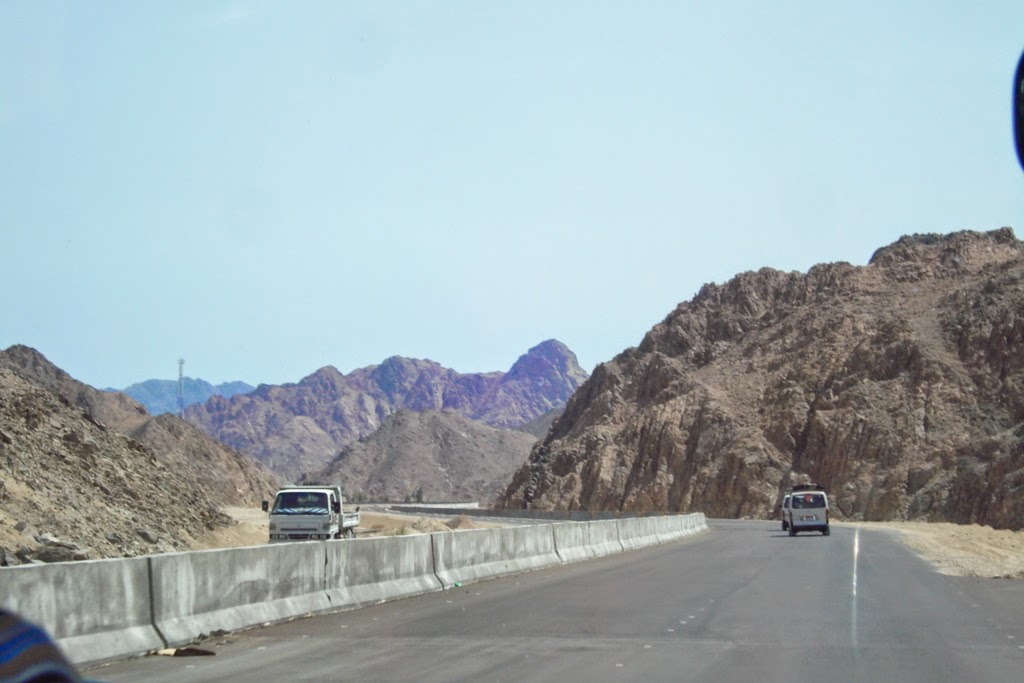
We set off in the morning from Luxor, boarding a van provided by Escapade Travel Transportation. Once we had driven through the town of Luxor we headed out into the vast expanse of sandy dunes.  The only greenery is near the Nile River Valley  so for most of the trip all we’d see was the vast stretch of dunes with occasional palm trees, shrubs or acacia trees.  Farther ahead were rocky crags and then more stretches of dunes.


Ever so many kilometers on the straight stretch of highway there was a check point where armed guards looked over the vehicle. On at least one occasion I saw sniffer dogs.  This was in no way disconcerting as it was similar to passing through border crossings.

The Sahara has one of the harshest climates in the world. Sand storms are common and the north-easterly wind is strong. Rainfall is rare, with the area receiving less than four inches or even less, a year. It’s interesting to note that thousands of years ago the Sahara was much more verdant. Evidence has been found of whale fossils and dinosaurs. Now the only areas with lots of vegetation are the Nile River Valley and some of the oases near the Mediterranean Sea. As for animals on the desert, we occasionally saw camels or goats which are the most domesticated animals in the desert.  These were mostly seen near places where there were oases or habitation.

As we neared the coast, the land was flat, stretching out like a buff-colored blanket. The highway was clear of traffic so we made good time reaching the coast, then turned south toward Soma Bay. Finally, I got my first glimpse of the Red Sea. And guess what?  It was turquoise!

NEXT:  Have I died and gone to Shangri-La?

THE KEMPINSKI SOMA BAY HOTEL RESORT


Sunday, May 18, 2014

THE MAJESTIC TEMPLES OF LUXOR AND KARNAK


Sphinx Avenue


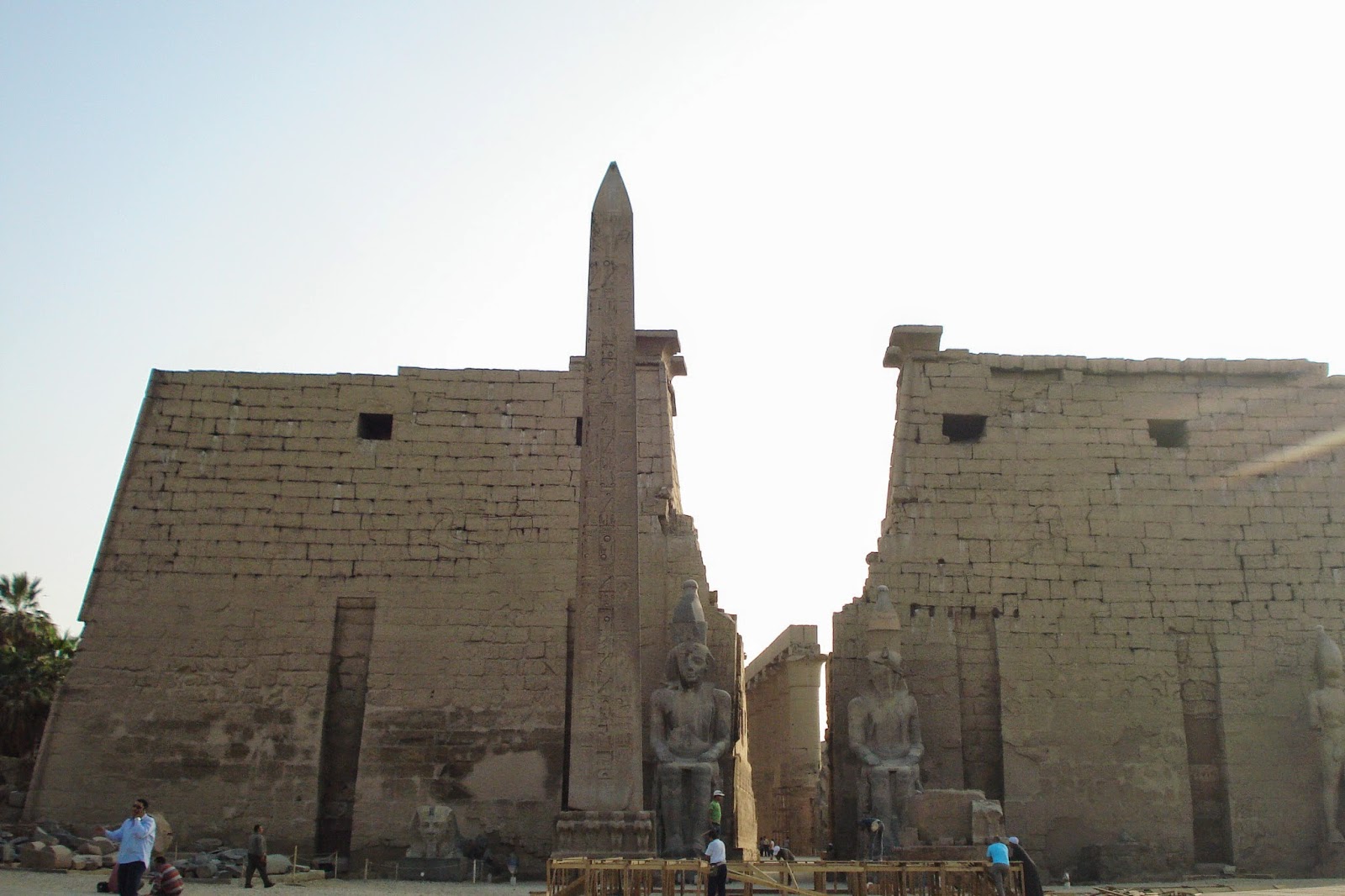
The city of Luxor is a pleasant city beside the Nile River, with a population of ½ million people. Right in the centre of Luxor (known as THEBES in ancient times), there is a magnificent temple built by Amenophis III (1417-1370 BC) and Rameses II (1104-1237 BC).  It is dedicated to the Theban Triad (Amun-Min, Mut and Khonsu). This is one of the most historic temples of ancient Egypt. The Egyptians called their temples ‘the houses of eternity’. Perhaps this is true, as they have so far outlasted time.  The long road leading to the temple is lined with small Sphinx statues.  At the entrance gate, workers were preparing seats for an evening light show.
 
 
We entered through the gates past a giant Sphinx  who greeted us with its enigmatic smile.


I was so excited when our Egyptologist, Hanan, led me into one of the inner chambers and pointed out the hieroglyphics on the wall that told of the arrival of Alexander the Great. Alexander visited there when he was on his Persian campaigns, stopping by Egypt to drive out the Persians who had invaded the country years before.  The Egyptians adored and honoured him, naming Alexander after Horus, the Son of God.  There on the wall, Hanan pointed out, was Alexander’s cartouche!  Below it some Greek visitors from the 1800’s had engraved their own names. Alexander dedicated one of the temple’s antechambers to the Sacred boat of Amun a replica of the god’s solar boat used during religious celebrations.

 
Greek graffiti
 

During the Roman period (284-105 AD) the temple was used as a military camp. There are still some restored paintings from that period at one end of the main building.  Later it was used as a church by the Christians and after that the Mosque of Abdul Haggag was built which stands alongside the temple wall.
 
 Mosque of Abdul Haggag


 North of Luxor’s city centre is Karnak, one of the largest religious complexes.  It was known as Ipet Isut which meant ‘the most select of places’. Over the years it was enlarged by various Pharaoh’s. It covered an area of 247 acres built around the Temple of Amun, and served as a spiritual centre and economic hub composed of temples , obelisks, pylons, courts, colonnades, halls, reliefs and sanctuaries.


As I approached it, down the long avenue of sphinx-like animals, I could not help but feel a bit overwhelmed.  The grandest feature of Karnak is the Great Hypostyle Hall which has 135 columns and includes the chapel of Senusert dating back to the Middle Kingdom. 
 

(sorry will fix later)


I was amazed at the massive height of the obelisks that tower over the buildings, one dedicated to Thutmose I and Hatshepsut  and one named ‘the botanical garden of Thumose II’ which is decorated with reliefs of plants, tress and animals
 

After this exhilarating and somewhat exhausting day of touring, we returned to the ship for dinner. We spent a relaxing evening in the bar entertained by a a belly dancer and the most amazing whirling dervish who could spin himself so fast he was a blur like a spinning top! 


NEXT: Tomorrow we disembark the ship and begin a cross-desert safari to the Red Sea.